Jump to…
Roofing reviews are homeowner ratings and feedback that signal whether a roofing contractor can be trusted with a high-cost, high-risk project. Because buyers cannot evaluate roofing workmanship before the job is finished, reviews become the primary signal homeowners use to decide who to call, inspect, and ultimately hire.
Roofing reviews influence close rates more than in most other home services. A homeowner spending $16,000 to $19,000 on a roof replacement cannot independently verify the quality of the work in advance, so they rely on proxy signals to reduce risk. Reviews are the most visible and trusted of those signals. Companies with strong, recent review profiles consistently close more jobs than competitors with weaker reputations, even when pricing and service quality are similar.
This article explains why reviews play such a decisive role in roofing decisions, how they influence homeowner psychology, and what contractors can do to build a review profile that improves close rates.
The Trust Problem Roofing Buyers Face
Most purchases in daily life are low-risk. If you buy a bad pair of shoes, you return them. If a restaurant disappoints, you don’t go back. The cost of a wrong decision is small and reversible.
Roofing is the opposite. The cost of a wrong decision is enormous and potentially irreversible. A poorly installed roof can leak, cause structural damage, void warranties, and cost thousands more to fix. And unlike a restaurant where you can taste the food before paying the full bill, you can’t evaluate a roof installation until it’s already on your house.
Behavioral economists call this a “credence good” problem. A credence good is a product or service whose quality the buyer can’t fully assess even after purchase. You can’t tell by looking at a finished roof whether the underlayment was installed correctly, whether the flashing was properly sealed, or whether the crew followed manufacturer specs. You have to trust that the contractor did it right.
This creates a trust gap that the homeowner has to close before they’re willing to commit. And in the absence of personal experience with your company, the primary tool they use to close that gap is other people’s experiences with your company. That’s what reviews are. They’re borrowed trust.
How Reviews Reduce Perceived Risk in High-Cost Decisions
When homeowners read your Google reviews, they are not just checking the star rating. They are looking for signs that hiring you is a safe decision.
They scan for patterns. If several people mention that you showed up on time, it suggests reliability. If multiple reviews talk about clear communication, it signals professionalism. If someone describes how you handled a problem during the project, it shows integrity. Reviews that mention insurance claims, inspections, or follow-through also reassure homeowners that you understand the complexity of the job.
Each of these signals reduces a specific type of risk the buyer is carrying:
Performance Risk
“Will this company actually do quality work?” Reviews that describe the finished product, mention attention to detail, or reference follow-up inspections address this directly.
Financial Risk
“Will I overpay or get hit with surprise charges?” Reviews that mention transparent pricing, honest estimates, or fair dealing reduce this concern.
Process Risk
“Will this be a nightmare to manage?” Reviews that describe smooth scheduling, clean job sites, responsive communication, and clear next steps ease this fear. For insurance-related work, reviews that mention the contractor’s ability to navigate the claims process are particularly powerful.
Social Risk
“Will I look foolish for choosing this company?” This is the risk people rarely say out loud but always feel. Choosing an unreliable contractor reflects poorly on the homeowner’s judgment. A strong review profile reassures them that others have made this choice and that it worked out well.
The more of these risk dimensions your reviews address, the faster the homeowner moves from “researching” to “ready to book.” That’s the direct link between reviews and close rates.
Why Volume and Recency Matter More Than a Perfect Score
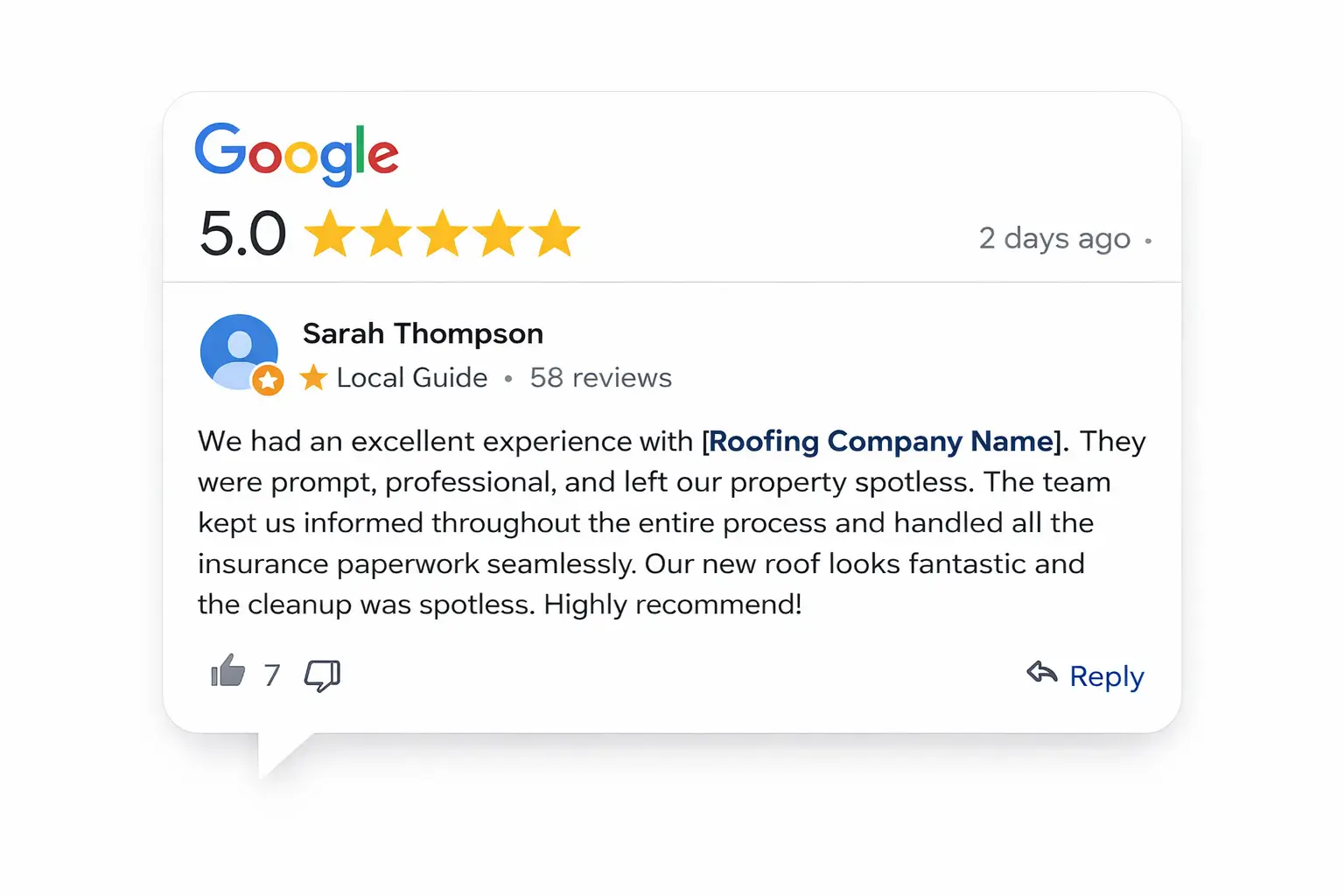
Many roofing contractors fixate on maintaining a perfect 5.0-star average. That instinct is understandable, but the data tells a different story.
A roofing company with 180 reviews at 4.7 stars will outperform one with 12 reviews at 5.0 stars in almost every measurable way: Map Pack placement, click-through rate, website conversion, and close rate. Here’s why.
Volume Signals Legitimacy
A large number of reviews tell the homeowner that your business has served many people and that many of them felt strongly enough about the experience to say so publicly. Twelve reviews could mean you opened last month. A hundred and eighty reviews say you’ve been doing this for a while, and the pattern is consistent.
Recency Signals Current Performance
A homeowner who looks at 2022 reviews has no idea whether your company still operates the same way. Reviews from the past 30 to 90 days show that you’re active, responsive, and currently delivering the quality your older reviews describe. Google’s algorithm also weighs recency when ranking businesses in the Map Pack. A steady flow of new reviews matters more than a large but stale collection.
Imperfection Signals Authenticity
Consumers have become more skeptical of perfect ratings. A 5.0 average with only positive reviews can actually trigger suspicion that the reviews are curated or fake. A 4.7 or 4.8 with a few lower ratings that you’ve responded to professionally tells a more credible story. It says you’re a real business that handles imperfection with maturity, which is exactly the kind of contractor a homeowner wants on their roof.
How You Respond to Reviews Matters as Much as the Reviews Themselves
Many roofing contractors treat review responses as an afterthought, but homeowners read those responses carefully. They reveal how the company actually operates.
A thoughtful reply to a positive review shows appreciation and reinforces trust. A calm, professional response to a negative review is even more important. It shows the company takes responsibility, handles problems professionally, and tries to resolve issues.
In a high-risk purchase like roofing, that matters. Homeowners want to know what happens if something goes wrong.
Ignoring negative reviews or responding defensively sends the wrong signal. Every response is public and helps shape how a potential next customer views your business.
The Compounding Effect: Reviews, Search Visibility, and Close Rates
Reviews do more than influence a homeowner’s decision after they find your business. They also affect whether your business appears in search results at all.
Google’s local search algorithm uses review signals when ranking businesses in the Map Pack. Review quantity, how frequently new reviews appear, your average rating, and the language used in reviews can all influence where your company shows up.
This creates a compounding effect. More reviews can improve your Map Pack visibility, which puts your business in front of more homeowners. More visibility leads to more jobs, and more jobs create more opportunities to collect reviews. Roofing companies that actively manage their reviews often improve both their close rates and the number of leads they receive.
Why Reviews Matter Even More During Storm Season
Storm season increases the need for trust in roofing decisions. Homeowners are dealing with visible damage, possible leaks, and the complexity of insurance claims. At the same time, many contractors enter the market, including out-of-town storm chasers and aggressive door-to-door sales teams.
With so many options, homeowners rely even more on trust signals. They cannot easily compare workmanship, and referrals may not be available when everyone in the area is dealing with the same storm. Reviews become the fastest way to judge which contractor feels reliable.
A roofing company with hundreds of recent reviews and a strong rating will often capture more storm-driven leads. Clear credibility stands out when homeowners are stressed and need to make a quick decision.
Contractors with few or weak reviews face a disadvantage, even if they spend heavily on advertising, because homeowners are less likely to trust them.
The Review-to-Close-Rate Pipeline: How It Works Step by Step
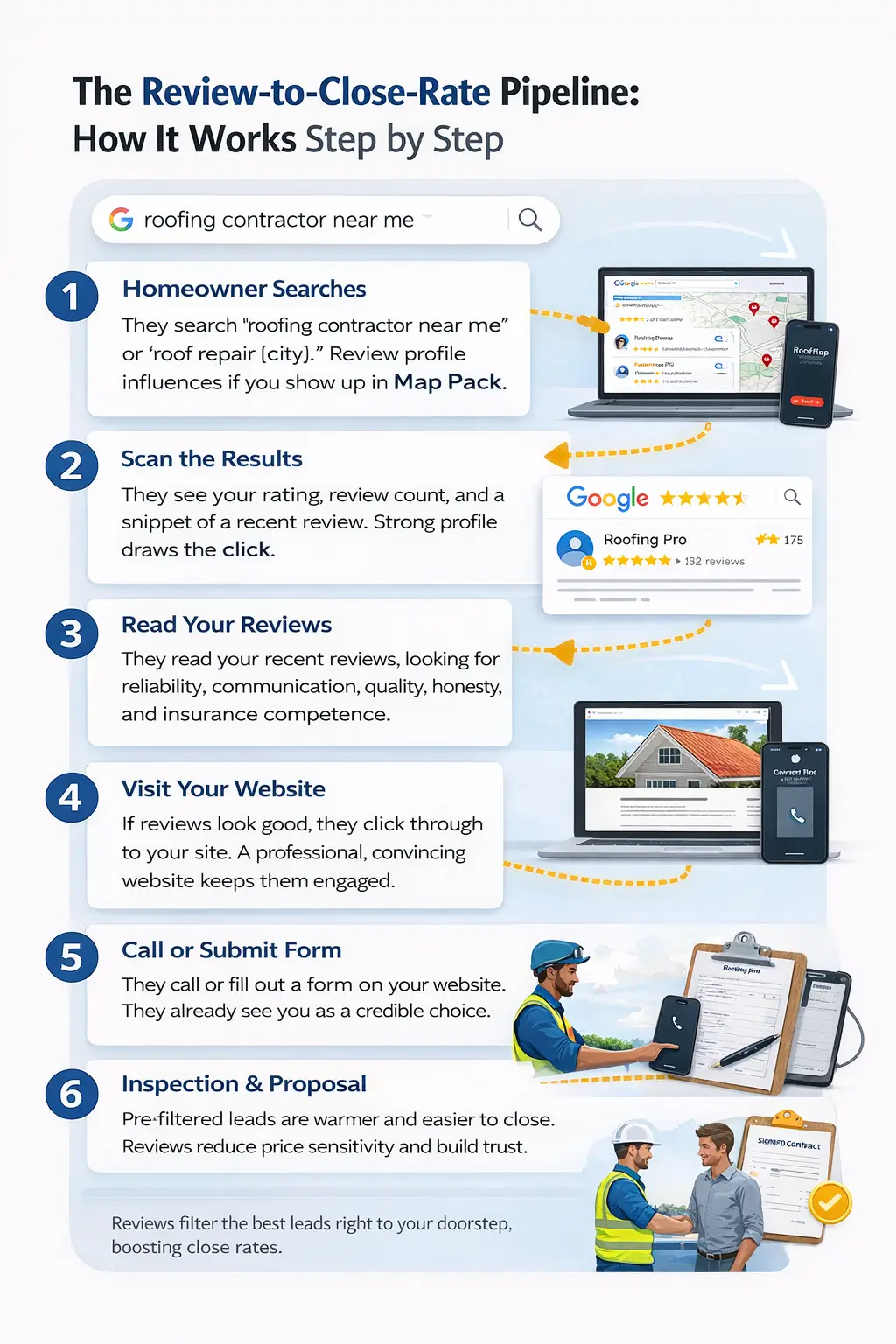
To understand why reviews affect close rates so directly, trace the homeowner’s journey from search to signed contract:
Step 1: The homeowner searches. They type “roofing contractor near me” or “roof repair [city].” Google returns results. Your Map Pack position, which is partly determined by your review profile, determines whether they see you at all.
Step 2: They scan the results. Before clicking, they see your star rating, review count, and a snippet of a recent review. A 4.8 with 175 reviews gets the click. A 3.9 with 22 reviews does not.
Step 3: They read your reviews. Not all of them. Consumers typically read 5 to 10 reviews before forming an opinion. They’re scanning for the risk signals described earlier: reliability, communication, quality, honesty, and insurance competence.
Step 4: They visit your website. If the reviews checked out, they click through to your site. Their expectations have already been shaped by what they read. A website that confirms those expectations (professional, clear, easy to contact) moves them forward. One that contradicts them (dated, confusing, no clear next step) stops the process cold.
Step 5: They call or submit a form. This is the lead. But notice how much filtering had already happened by this point. The homeowner has already decided you’re credible. Your team isn’t starting from zero on the phone. They’re talking to someone who has already chosen to trust you.
Step 6: The inspection and proposal. A lead who arrived with pre-built trust is easier to close. They’re less price-sensitive, more willing to listen to your recommendation, and less likely to ghost after the inspection. They’ve already vetted you. The close rate on these leads is fundamentally different from that of leads who found you through a shared lead service and know nothing about your reputation.
At every step, reviews either accelerate or block the homeowner’s progress toward a signed contract. That’s why the impact on close rates is so direct.
What Roofing Contractors Should Actually Do About This
Understanding the psychology is useful. But the actionable question is: what do you do with it? Here’s what moves the needle:
Build a Systematic Review Request Process
Don’t leave reviews to chance. Build a process where every completed job produces a review request within two to three days. A text message with a direct link to your Google Business Profile is the highest-converting method. Make it easy, make it timely, and make it part of your crew’s standard operating procedure, not an afterthought.
Respond to Every Review
Positive reviews get a genuine, specific thank-you. Negative reviews get a professional, empathetic response that acknowledges the issue and offers to make it right. Every response is written for the next prospective customer who will read it, not just for the person who left the review.
Prioritize Recency Over Perfection
A steady flow of 3 to 5 new reviews per month is more valuable than a burst of 20 followed by silence. Google rewards consistency, and homeowners trust recent reviews more than old ones. If your most recent review is four months old, it may signal that something has changed.
Encourage Specificity
When requesting reviews, gently encourage customers to mention what they valued most. Did your team handle the insurance process well? Were they responsive and communicative? Did the crew clean up after themselves? Reviews with specific details are more persuasive than generic five-star ratings because they address the specific risk concerns future buyers carry.
Don’t Incentivize or Fabricate
Google penalizes businesses caught soliciting fake reviews, and consumers are increasingly skilled at detecting them. The goal isn’t to manufacture a narrative. It’s to make it easy for genuinely satisfied customers to share their real experience. If you’re doing good work, the reviews will reflect it. Your job is to remove the friction that stops customers from writing them.
How Ad Genius Helps Roofing Contractors Build Review Authority
At Ad Genius, we treat reputation management as a core component of the marketing system, not a sidebar. For roofing contractors, your review profile directly affects your Map Pack ranking, GLSA placement, website conversion rate, and close rate. It’s not separate from lead generation. It is lead generation.
We help roofing contractors build review systems that produce a consistent flow of authentic, recent, detailed reviews. We also help with the broader strategy that reviews feed into: SEO authority, local visibility, brand positioning, and conversion optimization. The diagnosis determines which piece needs attention first.
If your roofing company has strong reviews but weak search visibility, the reviews aren’t reaching enough people. If you have strong visibility but a thin review profile, the visibility is underperforming. Both need to work together, and that’s what our approach is designed to build. Learn more about our digital marketing for roofing contractors.
Frequently Asked Questions
How many Google reviews does a roofing company need to be competitive?
There’s no universal number, but in most competitive markets, roofing contractors with 75 to 150+ reviews and a 4.5+ star average tend to dominate the Map Pack and outperform competitors in close rates. The exact threshold depends on your local market. What matters more than hitting a specific number is maintaining a consistent flow of recent reviews so your profile stays active and credible.
Does a perfect 5.0-star rating help or hurt?
It can actually hurt. Consumers have become more skeptical of perfect ratings, and a 5.0 with a small number of reviews can look curated or inauthentic. A 4.7 or 4.8 average with a high volume of reviews and a few professional responses to criticism tends to build more trust than a spotless but thin profile.
How do roofing reviews affect Google Map Pack rankings?
Google weighs review volume, recency, average rating, and keyword relevance when ranking businesses in the Map Pack. A roofing company with a strong, active review profile will rank higher than one with fewer or older reviews, all else being equal. This means reviews don’t just influence conversion. They influence visibility, which determines how many people see your business in the first place.
How should I respond to a negative roofing review?
Professionally, specifically, and without defensiveness. Acknowledge the concern, express that it doesn’t meet your standards, and offer to continue the conversation privately to resolve it. Every response is read by prospective customers as they evaluate whether to hire you. A thoughtful response to a complaint often builds more trust than a five-star review.
Why do reviews matter more for roofing than other home services?
Because roofing is a high-cost, high-risk credence good. The homeowner can’t evaluate the quality of the work before the job is done, and the financial exposure is significant. In decisions like these, people rely more heavily on social proof to reduce perceived risk. Reviews are the most accessible form of social proof available, which is why their influence on close rates in roofing is disproportionately large compared to lower-cost services.
Can reviews improve my close rate even if my pricing is higher than my competitors’?
Yes. A strong review profile shifts the conversation from price to trust. A homeowner choosing between a contractor with 200 reviews at 4.8 stars and one with 30 reviews at 4.2 stars will often choose the more-reviewed contractor, even at a higher price, because the perceived risk of the cheaper option feels greater. Reviews give you permission to charge what your work is worth by reducing the buyer’s uncertainty about what they’ll receive.
How quickly should I request a review after completing a job?
Two to three days after completion is the ideal window. Soon enough, the experience is fresh, and the customer remains positive about the result, with enough time to appreciate the finished product. A text message with a direct link to your Google Business Profile is the highest-converting format. Don’t wait weeks. The longer you wait, the less likely the review is to happen.
Ready to Turn Your Reputation Into a Growth Engine?
If you’re an established roofing contractor and your review profile isn’t actively building trust and driving inspections, your competitors are gaining an advantage every day. Talk with Ad Genius to evaluate your current review profile and build a system that consistently strengthens credibility and improves close rates.
Schedule a strategy call to get started.