Jump to…
Retail vs. storm roofing demand refers to the two ways homeowners enter the roofing market: urgent, insurance-driven storm damage and slower, research-driven retail replacement. Each follows different timelines, trust signals, and buyer behaviors.
Retail roofing and storm roofing produce revenue through fundamentally different decision cycles. Storm demand appears suddenly after weather events and is often tied to insurance claims, creating short windows where homeowners prioritize speed and credibility. Retail demand develops gradually as roofs age, homeowners research options, and compare contractors over weeks or months.
Because the triggers and decision timelines are different, the marketing approach cannot be the same. Companies that treat both demand types identically often overspend during storm windows and struggle to convert retail leads during quieter months.
Roofing contractors that build separate strategies for storm and retail demand can stabilize revenue year-round, reduce dependence on weather events, and maintain stronger close rates across both channels.
How Storm Demand Actually Works
Storm roofing demand is event-driven. A hailstorm or wind event creates a sudden surge of homeowners who need inspections, damage assessments, and possible roof replacements.
After a major storm, competition spikes quickly. Roofing companies begin door knocking, advertising budgets increase, and out-of-town storm contractors often enter the market. Online advertising costs also rise as multiple companies compete for the same urgent searches.
Homeowners in this situation are usually dealing with uncertainty. Many do not know the extent of the damage or how the insurance claim process works. As a result, they prioritize speed, local credibility, and a contractor who understands insurance documentation.
Storm work can generate significant revenue, but it is also temporary and unpredictable. Once claims are processed and repairs are completed, demand drops quickly. Companies that rely entirely on storm work often experience sharp revenue swings between storm seasons.
How Retail Demand Actually Works
Retail roofing demand is lifecycle-driven, not event-driven. Homeowners begin considering replacement as their roof ages, leaks develop, or inspections reveal deterioration.
Unlike storm buyers, retail customers move slowly. They research contractors online, read reviews, request multiple estimates, and compare materials and pricing before making a decision. The buying process can take weeks or months.
Because the homeowner is usually paying out of pocket, credibility and professionalism are more important. Retail marketing must build trust over time through strong reviews, clear information, and a professional online presence.
Retail demand grows more gradually than storm demand, but it is also more stable. For established roofing contractors, retail work provides consistent revenue between storm events and helps keep crews working year-round.
Why the Marketing Strategy Must Be Separate
The reason these two demand types require different marketing strategies comes down to three differences that affect every tactical decision.
Difference 1: Timing and Urgency
Storm demand compresses the decision timeline into days. Retail demand stretches it across weeks or months. This affects everything from ad copy to landing page structure to follow-up cadence. Storm campaigns need to communicate speed and availability. Retail campaigns need to communicate expertise and clarity of process.
Difference 2: Who Is Paying
Storm work frequently involves insurance. Retail work is typically self-funded by the homeowner. Insurance-backed buyers evaluate contractors differently from cash buyers. They want someone who can manage the claim, negotiate supplements, and simplify the process. Retail buyers want clarity on pricing, materials, warranties, and the installation timeline. Marketing that speaks to one without addressing the other leaves value on the table.
Difference 3: Trust Formation
Storm buyers form trust quickly and under pressure. They look for signals like local presence, strong reviews, licensing visibility, and responsiveness. Retail buyers form trust gradually. They evaluate your website quality, read multiple reviews, compare your online presence to competitors, and assess your professionalism before making contact. If your marketing only builds the fast-trust signals that storm buyers need, retail buyers will not find the depth they require.
What Storm Roofing Marketing Should Prioritize
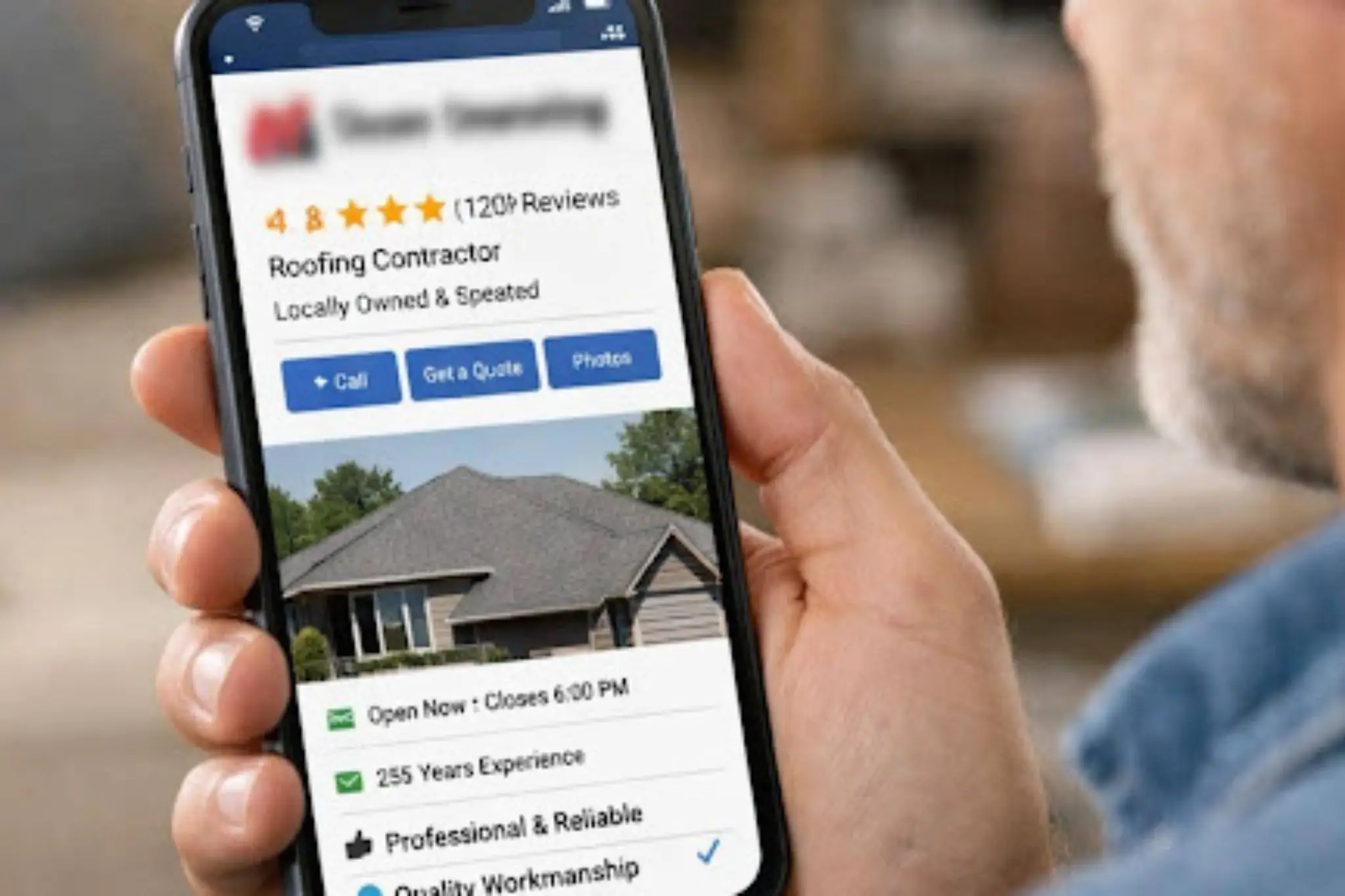
Storm marketing is about readiness and speed. The opportunity window is short, so contractors must already be positioned when the storm hits.
Google Ads and Local Services Ads should be pre-built and ready to activate immediately. Storm-specific campaigns with the right keywords and service-area targeting allow budgets to scale within hours after an event. Waiting to build campaigns after the storm usually means competing too late.
A strong Google Business Profile is another major advantage during storm demand. Homeowners often choose from the Map Pack when searching right after damage. Contractors with more reviews, stronger ratings, and a complete profile win those clicks.
Your website messaging should also address insurance claims directly. Homeowners dealing with storm damage want a contractor who understands inspections, documentation, and the claims process. Generic “free estimate” messaging does not answer their biggest concern.
Finally, response speed matters. Storm demand comes in fast. If calls are missed, forms go unanswered, or inspections are delayed, the lead is lost to another contractor. Marketing captures the demand, but fast intake and scheduling convert it.
What Retail Roofing Marketing Should Prioritize
Retail roofing marketing is about authority, consistency, and long-term visibility.
Organic search (SEO) is the most important channel for retail demand. Homeowners researching roof replacements search for terms like “roof replacement cost,” “roofing contractor near me,” and material comparisons over several weeks. A structured roofing SEO strategy helps contractors capture this demand throughout the research phase.
Website quality also plays a major role. Retail buyers spending $15,000–$20,000 out of pocket carefully review contractor websites. Clear service explanations, project photos, process details, and strong reviews help build trust and improve close rates.
Reviews influence retail buyers differently from storm buyers. Instead of just looking at star ratings, homeowners read reviews that describe communication, timelines, cleanup, and overall experience. Detailed reviews build confidence during the research phase.
Paid ads can support retail demand, but should not replace organic visibility. Google Ads targeting replacement and upgrade keywords can generate leads, but SEO and strong website content guide homeowners through the longer decision-making process and ultimately drive conversions.
The Revenue Stability Argument for Retail Investment
Roofing contractors who invest heavily in storm marketing but neglect retail are building a business that performs well during weather events but struggles in between. This is a structural vulnerability, not a marketing one.
Retail demand does not spike and crash. It compounds. The organic authority you build today continues generating leads six months from now. The reviews you earn from retail projects build credibility that supports both retail and storm close rates. The depth of the website you develop for retail buyers also improves the experience for every other visitor.
Contractors who treat retail as an afterthought often face crew underutilization during non-storm months, cash-flow pressure that forces reactive spending when the next event hits, and dependence on lead aggregators or door-knocking to fill gaps. Retail investment solves these problems structurally.
The most resilient roofing companies do both. They capture storm demand efficiently when it arrives, and they build retail authority that sustains the business when it does not.
Common Mistakes When Blending Storm and Retail Marketing
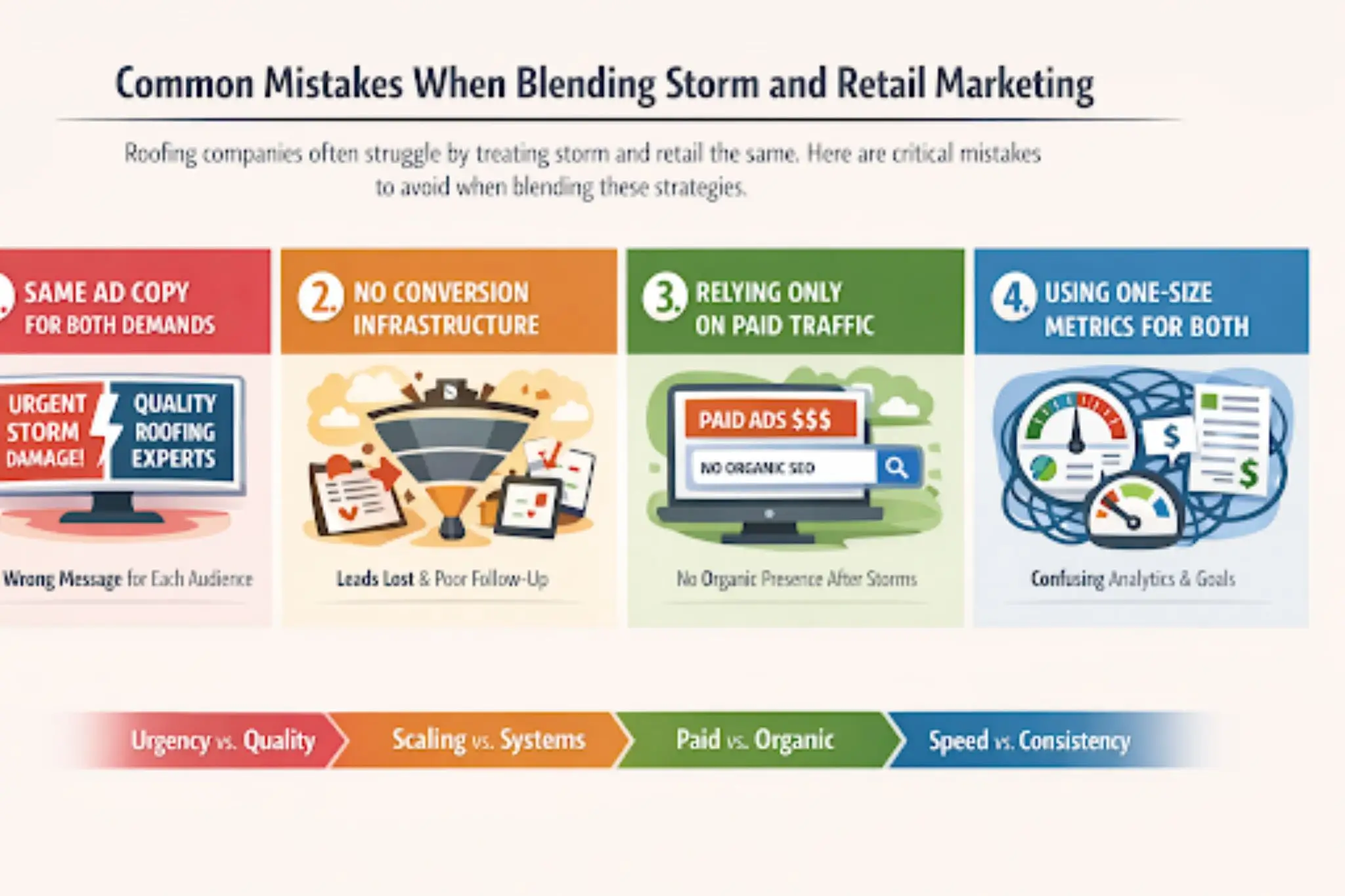
Many roofing companies struggle because they treat storm and retail marketing as the same system. In reality, each demand type requires different messaging, infrastructure, and performance metrics.
When these differences are ignored, marketing spend becomes inefficient and close rates become unpredictable. The following are the most common mistakes contractors make when blending storm and retail strategies.
1. Running the same ad copy for both demand types
Storm buyers respond to urgency and insurance language. Retail buyers respond to quality, process, and expertise. A single campaign that tries to speak to both ends up resonating with neither.
2. Scaling storm spend without conversion infrastructure
Increasing ad budgets after a weather event without ensuring that intake systems, scheduling, and follow-up are ready to absorb the volume. This results in a high cost per lead and low close rates during the most expensive advertising window of the year.
3. Neglecting organic visibility because paid is working during storms
Paid channels feel productive when storm demand is high. But they mask a structural gap. When the storm passes, and pay spends normalize, the contractor has no organic base to sustain lead flow.
4. Measuring storm and retail performance with the same metrics
Storm marketing should be measured by speed to contact, inspection booking rate, and cost per approved claim. Retail marketing should be measured by cost per signed contract, organic visibility growth, and consistency in close rate. Blending them into a single dashboard obscures where each system is performing or failing.
How to Structure a Dual Strategy
A dual strategy does not mean doubling your marketing budget. It means segmenting your existing investment so each dollar works within the demand type it is designed for.
Storm campaigns should be pre-built, geo-targeted, and ready to activate quickly. They should have their own budget allocation, messaging, and landing pages. When a weather event occurs, you scale them immediately and measure performance against storm-specific KPIs.
Retail campaigns should run continuously. They should support organic authority growth, maintain review velocity, reinforce website credibility, and capture planned replacement demand through both search and paid channels. Their budget should remain stable regardless of whether it stormed last week.
The overlap between the two strategies is credibility. Strong reviews, a professional website, and local search authority benefit both storm and retail performance. Building that foundation is not a cost. It is the asset that makes every marketing dollar more efficient across both demand types.
Frequently Asked Questions
What is the difference between retail roofing and storm roofing?
Storm roofing involves insurance-driven projects triggered by weather damage. Retail roofing involves homeowner-funded replacements and repairs driven by aging, performance decline, or proactive upgrade decisions. The buyer psychology, decision timeline, and trust formation process are fundamentally different.
Can roofing companies market to both retail and storm at the same time?
Yes, and the most resilient roofing businesses do. The key is running separate strategies for each. Storm campaigns should activate quickly during weather events with insurance-focused messaging. Retail campaigns should run continuously with authority and trust-based positioning. Blending them into one campaign weakens performance for both.
Why is retail roofing marketing harder than storm marketing?
Retail buyers take longer to decide, compare more contractors, and scrutinize credibility more carefully. They are spending their own money on a planned project, which raises the trust threshold. Retail marketing requires deeper organic authority, stronger website presentation, and more detailed review profiles to convert effectively.
How should roofing ad campaigns be structured differently for storm vs. retail?
Storm campaigns need pre-built ad groups with urgent keywords, insurance-focused landing pages, and budget flexibility to scale quickly after weather events. Retail campaigns should target replacement and cost-research keywords with steady budgets and landing pages that support the longer decision cycle. Separate campaigns allow separate measurement and optimization.
What role does SEO play in retail roofing marketing?
Organic search authority is the most important channel for retail demand. Homeowners planning replacements research over weeks, repeatedly visiting search results for cost, material, and contractor comparison queries. The contractor with consistent organic visibility during that research phase earns trust before the first phone call.
Why do some roofing companies struggle between storm seasons?
Companies that invest primarily in storm marketing have no organic foundation or retail demand capture system to sustain lead flow when weather events are not occurring. Crews go idle, cash flow becomes uneven, and the pressure to overspend during the next storm increases. Retail marketing investment solves this structurally.
Should storm roofing marketing mention insurance directly?
Yes, but carefully. Homeowners dealing with storm damage want to know that you understand the claims process, can document damage properly, and will work with their carrier professionally. Marketing that demonstrates insurance fluency builds trust. Marketing that overpromises on claim outcomes can create legal risk and erode credibility.
What metrics should roofing companies track differently for storm vs. retail?
Storm performance should be measured by speed to contact, inspection booking rate, insurance claim approval rate, and cost per approved project. Retail performance should be tracked through cost per signed contract, organic visibility growth, review velocity, close rate by lead source, and revenue stability across non-storm months.
How much does the average retail roof replacement cost?
National averages for a residential asphalt shingle replacement generally range from $7,000 to $15,000 or more, depending on roof size, pitch, material selection, and market. Higher-end materials like metal or tile push costs significantly higher. These figures matter because retail buyers are spending their own money, which makes trust, professionalism, and perceived value critical to close rates.
Find What’s Actually Limiting Your Roofing Lead Flow
If storm seasons drive most of your revenue but retail months slow down, the issue usually isn’t demand. It’s how your marketing is structured. At Ad Genius, we help roofing contractors build systems that capture storm demand quickly while generating steady retail leads year-round.
Ad Genius helps HVAC companies build the digital infrastructure that supports consistent growth from SEO and Google Business Profile optimization to conversion-focused websites.
Schedule a strategy call, and we’ll review your current marketing channels, identify where leads are leaking, and show you the fastest path to stabilizing revenue.