Jump to…

HVAC SEO is one of the most competitive categories in local search. When a homeowner’s AC dies in July, they don’t scroll through options. They search, pick one of the first results, and call.
That urgency is exactly why so many HVAC companies are fighting over the same small handful of search positions, and why most of them are spending more than they should to get calls that their competitors are getting for free.
Who You’re Actually Competing Against
Most HVAC contractors think their competition is the guy two zip codes over. It’s not only him. In a competitive metro market, you’re up against three distinct groups at once.
Other local contractors
In markets like Phoenix, Dallas, or Atlanta, there can be 50 to 80 actively marketed HVAC companies chasing the same search terms. According to the U.S. Bureau of Labor Statistics, there are more than 120,000 HVAC contractor businesses operating nationally. Even in mid-size markets, the competition is real.
Private equity-backed HVAC companies
Over the last several years, large investment groups have been buying up local HVAC businesses at a fast pace. When they acquire a company, the old website gets replaced with a fully funded SEO operation. A competitor that had a basic website two years ago may now have a full content team, a managed Google Business Profile, and a paid media budget.
Lead aggregators
Platforms like Angi, HomeAdvisor, and Thumbtack show up in the organic search results for the same terms you need. They’ve invested in SEO at a national scale that no individual contractor can match. They’re not your competition in the traditional sense, but they’re occupying search real estate that should be yours, and then selling those leads back to you.
The result: local search is being contested from three directions at once. That’s why HVAC SEO feels harder than it used to be. It is.
Why the Summer Rush Makes SEO Even Harder
HVAC search volume doesn’t stay steady all year. It spikes hard during summer heat events and winter equipment failures. In warmer climates, peak AC repair demand can be packed into a six-to-eight-week window. In northern states, a January cold snap generates more furnace search volume in 72 hours than the two months before it.
Here’s the problem: every HVAC company in your market is pushing harder during those same windows. Pay-per-click costs go up. Competitors publish content. Review velocity picks up as busy technicians serve more customers. A company holding a strong map pack spot in April can lose it by August if a competitor was grinding reviews and content while they weren’t.
The search terms shift during demand spikes, too. Phrases like ‘AC not cooling,’ ‘furnace won’t start,’ and ‘HVAC repair near me’ all surge at the same time as standard installation searches. Emergency service calls and installation jobs follow different search patterns, and a smart HVAC SEO strategy treats them separately.
The bottom line: SEO built in September helps you win in November. Authority built in February helps you win in June. The contractors consistently showing up at peak season started working on it months earlier.
Why the Map Pack Is Tough to Hold
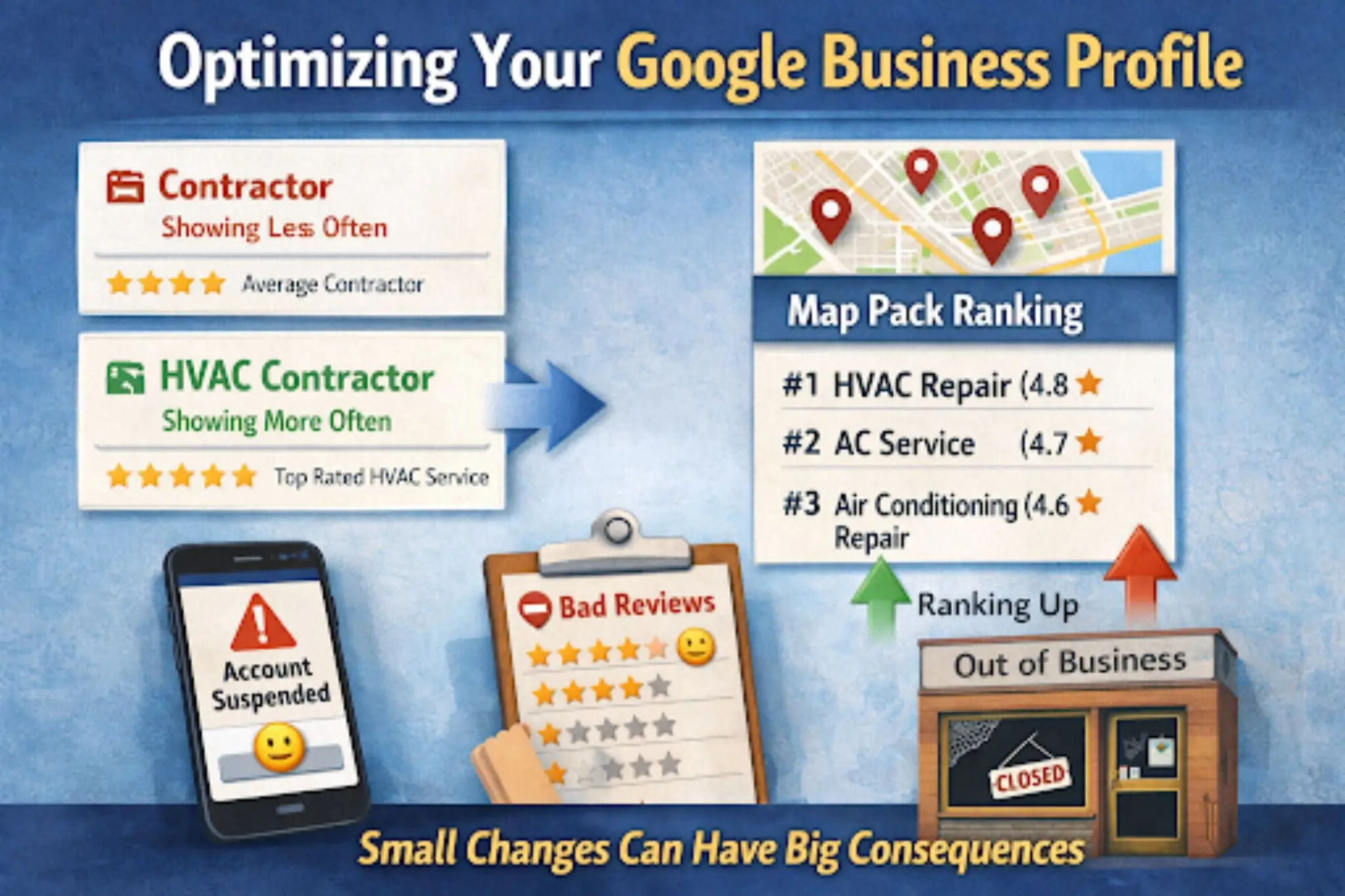
For most HVAC searches, the map pack, the three local listings that appear under the Google map, is where the calls come from. Homeowners in an emergency rarely scroll past it. Those three spots are the real contest.
Your location relative to the searcher
Most HVAC companies cover a wide service area from one address. Google weights results toward businesses closest to the person searching. If your office is in the suburbs but someone is searching from downtown, you’re starting at a disadvantage. That can be managed, but not eliminated.
Review recency, not just review count
A company with 400 reviews that got 2 new ones this month competes poorly against a company with 180 reviews that got 14 this month. Google looks at how recently reviews are coming in, not just the total number. Companies that ran a push to get reviews two years ago and stopped are slowly falling behind.
How your Google Business Profile is set up
Your GBP primary category determines which searches you’re eligible to show up for. A company listed as ‘contractor’ instead of ‘HVAC contractor’ or ‘air conditioning repair service’ can miss out on the exact searches that produce the most valuable calls. Small configuration details have real consequences in a competitive market.
One rough stretch of bad reviews, a GBP suspension, or several months of inactivity can push a company out of a spot it held for years. Map pack rankings are earned every month, not once.
The Lead Aggregator Problem
Angi, HomeAdvisor, Thumbtack, and similar platforms regularly rank at the top of local HVAC searches. They’ve spent heavily to build that presence, and they’re not going anywhere.
Their model works like this: they rank for terms you need, collect the homeowner’s information, and sell that lead to multiple contractors at once. You pay for a lead that your competitor also paid for. The price per lead in HVAC is not cheap because the search competition is high. It’s a cycle that benefits them.
This isn’t a complaint about the platforms. It’s a description of the market. HVAC contractors who build their own organic presence, strong search rankings, consistent reviews, and a healthy map pack position get calls that never pass through a lead resale funnel. Contractors who don’t build that presence keep buying leads from a market the aggregators control.
Why Maintenance Plans Change Your SEO Strategy
HVAC companies with active maintenance agreements operate differently from those that rely on emergency calls. Maintenance customers schedule in advance. They call before the breakdown. They refer their neighbors. According to data from the Air Conditioning, Heating and Refrigeration News (ACHR News) and ACCA contractor research, companies with strong maintenance programs produce more consistent revenue and retain customers at higher rates.
A company with 800 active maintenance agreements doesn’t need to win every emergency search to stay busy. That gives them room to invest in SEO for installation keywords and longer-term content, without panicking every slow week in October.
A company with very few maintenance customers needs the emergency call to survive. That forces short-term thinking: chase the high-urgency, high-competition keywords right now, because next month’s slow season is already a concern.
The gap between those two types of companies widens over time. Those with strong recurring revenue consistently invest in SEO. That consistent investment compounds. The ones chasing emergency calls compete tactically and never build lasting search authority.
The Three Keyword Tiers HVAC Contractors Compete For

HVAC searches fall into three clear groups. Most contractors only fight for two of them.
Emergency and repair searches (most competition, fastest conversions)
- “AC repair [city]”
- “Furnace repair near me”
- “HVAC emergency service [city]”
- “Air conditioning not working [city]”
Installation and replacement searches (high competition, longer decision cycle)
- “AC installation [city]”
- “HVAC replacement [city]”
- “New furnace cost [city]”
- “HVAC company [city]”
Maintenance and tune-up searches (less competition, higher long-term value)
- “HVAC maintenance plan [city]”
- “AC tune-up [city]”
- “Furnace inspection near me”
Most HVAC companies only go after emergency and installation terms because those are the calls they want today. That concentrates all the competition at the most expensive, most contested end of the keyword list.
Companies that build content and authority across all three tiers are harder to knock out. They capture homeowners at different points in the decision process. They also signal to search engines that they’re the real subject-matter authority on HVAC, not just another contractor listing services.
Why Most HVAC SEO Doesn’t Work
The failures are consistent. Once you’ve seen them enough times, they become predictable.
Generic content
A page that reads the same as a plumber’s page doesn’t build HVAC authority with Google. ‘HVAC Services in [City]’ with three paragraphs and a phone number isn’t competing with well-built sites. It doesn’t exist to them.
Seasonal content was published too late
Publishing a ‘summer AC tips’ post in July misses the window. That post needed to be indexed and gain traction in April. Seasonal content published during the peak earns visibility after the season slows down, which is too late to matter.
A neglected Google Business Profile
The map pack is where most HVAC calls start, yet many companies leave their GBP on autopilot. Wrong category setup. No recent photos. Unanswered reviews. When three competitors are actively managing their profiles, and you’re not, the rankings will reflect that.
Thin service pages
A page that lists services without explaining anything useful doesn’t demonstrate expertise. Google rewards pages that actually help the reader, covering what a service call involves, how pricing works, or when a repair makes more sense than a replacement.
Blog posts that don’t connect to anything
An isolated blog post that doesn’t link to the main service pages isn’t doing much. Links carry authority through the site. Content that earns attention but doesn’t drive visitors to commercial pages generates traffic without leads.
What Actually Works in a Competitive HVAC Market
The contractors holding strong map pack positions in contested markets aren’t there by luck. Here’s what they’re doing.
Content that reflects how HVAC actually works
Not ‘HVAC tips for homeowners.’ Content that covers real operational realities: how emergency demand spikes in heat waves, why maintenance plans change the economics of the slow season, what a system replacement decision actually looks like for a homeowner weighing a repair versus a new unit. That specificity is what signals genuine expertise.
A managed Google Business Profile
Primary category set correctly. Service area configured accurately. Photos updated regularly. Reviews responded to. Posts published. This isn’t a one-time setup. It’s an ongoing maintenance task, and the companies that treat it that way hold their map pack positions.
A review process that runs automatically
Review velocity is a ranking input. The companies consistently in the map pack have a system for asking every customer for a review after every job. It’s not a quarterly email blast. It’s built into service delivery.
Keywords across all three demand tiers
Emergency terms, installation terms, and maintenance terms all represent different buyers. A content strategy that addresses all three captures demand at every stage of the service cycle and builds broader topical authority than emergency-only content ever can.
Internal linking that routes authority to the right pages
Blog content should link upward to the service and industry pages that target the commercial keywords. Content that earns attention but doesn’t support the structural pages distributes authority into dead ends.
The contractors holding local pack positions in contested HVAC markets built their visibility consistently, with content that reflects how their trade actually works. That’s how the market rewards HVAC SEO, and that’s what separates the ones getting direct calls from the ones still buying leads.
Frequently Asked Questions
Why is HVAC one of the most competitive industries for local SEO?
HVAC searches are high-urgency and high-value. When a system fails, the homeowner needs help fast and is willing to pay for it. That combination draws heavy competition from local contractors, PE-backed operators, national brands, and lead aggregators, all targeting the same small set of local search positions
How many HVAC companies are competing in a typical local market?
Mid-size markets typically have 30 to 60 active, marketed HVAC companies. Not all invest in SEO equally, but the ones that do have grown more sophisticated over the last several years. The practical contest for map pack positions is usually among the top 10 to 15 most actively optimized companies in a given area.
What keywords do HVAC companies need to rank for?
There are three groups: emergency repair terms like ‘AC repair [city],’ installation terms like ‘HVAC replacement [city],’ and maintenance terms like ‘HVAC tune-up [city].’ Most contractors only compete for the first two. Building authority across all three is what creates durable search visibility instead of seasonal battles.
How does the Google map pack work for HVAC searches?
The map pack shows the top three local businesses for location-based searches. Google determines who appears based on proximity to the searcher, Google Business Profile signals such as category setup and review activity, and the business’s overall online authority. For emergency HVAC searches, the map pack captures most of the clicks because searchers want a fast, credible answer.
Can a local HVAC company outrank national brands?
Yes, specifically in the map pack. National brands have advantages in standard organic results, but the local pack is driven by proximity, GBP management, and review signals. A well-run local operator can consistently outperform national brands in the map pack. Lead aggregator sites are harder to displace in organic results, which is why map pack rankings are the priority for most local HVAC contractors.
How long does HVAC SEO take to show results?
Map pack improvements with active GBP management and consistent review acquisition can appear within three to six months. Organic rankings for competitive service and installation terms in dense markets typically take six to twelve months of steady work. HVAC SEO in a competitive market is not a short-term tactic.
Should HVAC companies invest in SEO year-round or only before peak season?
Year-round. SEO authority builds on itself over time. A company that only invests before summer enters every peak season behind the competitors who never stopped. Content published in February, reviews earned in January, and a GBP maintained in the off-season all contribute to where you rank when demand spikes.
What is review velocity and why does it matter for HVAC SEO?
Review velocity is the rate at which new reviews come in. Google looks at recency, not just total count. A company with 180 reviews and 14 new ones this month outranks a company with 400 reviews and 2 new ones in most map pack contexts. HVAC companies need a consistent system for asking every customer for a review, not a one-time push.
What’s the most common reason HVAC SEO fails to produce leads?
Generic content is the most common problem. Pages that list services without specificity, blog posts that aren’t relevant to real HVAC buyer questions, and a neglected GBP are the three issues that show up most often. The companies that fix all three consistently tend to hold the search positions that produce direct calls.
See What’s Holding Back Your HVAC Search Visibility
If your calls spike in peak season but drop off after, the issue usually isn’t demand. It’s your search visibility. At Ad Genius, we help HVAC companies build SEO and map pack presence before the rush so they generate consistent calls. Schedule a strategy call and we’ll show you where you’re losing ground and how to fix it.