Jump to…
- Quick Answer: What Is the Average Google Local Services Ads Cost Per Lead in 2026?
- Average Google Local Services Ads Cost Per Lead in 2026
- How Much Do Google Ads and Google Local Services Ads Cost in 2026?
- HVAC Google Local Services Ads Cost Per Lead Benchmarks
- Google Ads Cost Per Lead for Home Services
- Why Google Local Services Ads Cost Per Lead Increased in 2026
- What Impacts Google Local Services Ads Cost Per Lead Most?
- Cost Per Lead vs Cost Per Booked Appointment
- Common Problems With Google Local Services Ads
- How To Lower Google Local Services Ads Cost Per Lead
- Are Google Local Services Ads Worth It for Home Service Companies in 2026?
- Where Google Local Services Ads Fit in Your Marketing Mix
- Frequently Asked Questions About Google Local Services Ads Cost Per Lead
- Talk to a Strategist About Your LSA Strategy
- About the Author: Brett Williamson

Google Local Services Ads, often called LSAs or GLSAs, charge per qualified lead rather than per click. That makes the math simpler than traditional pay-per-click, but it does not make it cheap. CPLs have risen sharply since 2023 as more contractors crowded into the platform, and what a contractor pays for a single phone call varies more by market and operations than most owners realize.
This guide breaks down current LSA cost-per-lead benchmarks by trade and market, explains how Google calculates lead pricing, compares LSAs to standard Google Ads, and shows the operational levers that determine whether a $50 lead becomes a $200 booked job or a $50 loss.
Average Google Local Services Ads Cost Per Lead in 2026
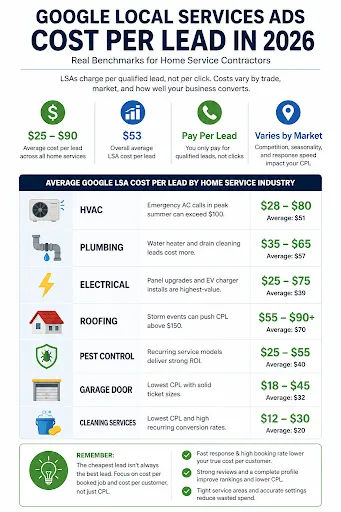
Across home service trades, LSA cost per lead in early 2026 averages around $53, based on observed industry data covering hundreds of contractors and millions of dollars in spend. The range across categories runs from roughly $25 to $90, with high-competition emergency categories pushing higher.
These are averages. The same trade in two different ZIP codes can produce CPLs that differ by 4x or more, driven entirely by the number of local competitors bidding for the same calls.
Average LSA Cost Per Lead by Home Service Industry
The following ranges reflect industry-reported benchmarks from early 2026. Use them as a directional starting point, not a fixed expectation.
HVAC
HVAC LSA leads average around $51, with a typical range of $28 to $80. Emergency AC calls during peak summer months can push CPL above $100 in major metros. February heating-season data show strong book rates and high average ticket sizes, which keep HVAC among the most profitable LSA categories despite higher lead costs.
Plumbing
Plumbing LSA leads average around $57, with a typical range of $35 to $65. Queries about water heater replacement and drain cleaning command higher CPLs than general maintenance calls. Plumbing book rates near 44 percent, and average tickets above $1,700 keep the math favorable for operators with strong intake.
Electrical
Electrical LSA leads average around $39, with a typical range of $40 to $75 in competitive metros. Panel upgrades and EV charger installation queries are the highest-value lead types and tend to cost more per lead. EV charger installation is one of the clearest underutilized opportunities in residential electrical right now, with high intent and limited contractor competition on dedicated landing pages.
Roofing
Roofing LSA CPLs run higher than most home service categories, typically $55 to $90 per lead and reaching $150 or more during active storm events. Storm damage queries spike during weather events and pull insurance-driven buyers, which justifies the higher cost for contractors who handle insurance work effectively.
Pest Control
Pest control LSA leads land in the $25-$55 range, with recurring service models delivering strong unit economics. The combination of moderate CPL and recurring revenue makes pest control one of the more forgiving categories for newer LSA accounts.
Garage Door
Garage door LSA leads run $18 to $45 in most markets, among the lowest CPLs in home services. Spring replacements, opener installations, and full door replacements command solid ticket sizes, making garage door one of the highest-ROI LSA verticals relative to ad spend.
Cleaning Services
House cleaning LSA leads run $12 to $30, the lowest among home service categories. The combination of low CPL and recurring conversion rates of 30 to 40 percent gives cleaning companies some of the strongest LSA economics of any category.
Average Google Local Services Ads Cost Per Lead by Market Size
Geography drives CPL more than most contractors realize. The same trade in the same season can cost 3x more per lead in one city than another.
Large Metro Areas
Major metros like Phoenix, Dallas, Los Angeles, and Atlanta produce the highest LSA CPLs. HVAC in major metros runs $45 to $80 per lead, and emergency categories can exceed $100. Competition density is the main driver. More contractors bidding for the same calls drives up the price every contractor pays.
Mid-Sized Cities
Mid-sized markets see CPLs 30 to 50 percent lower than in major metros. HVAC in these markets runs $28 to $45 per lead. Competition is lower, and contractors with strong review profiles and fast response times can dominate the share without paying metro rates.
Smaller Local Markets
Smaller markets produce the lowest CPLs but also the lowest lead volume. CPLs for garage door, handyman, and pest control can drop to $15 to $30 in smaller markets. The challenge is not the lead cost but having enough demand to fill the schedule consistently.
Emergency Service Leads vs Standard Service Leads
Emergency leads cost more per lead but typically close at higher rates and higher tickets. A burst pipe call, a no-AC summer call, or a storm damage roofing call carries urgency that converts faster than a planned maintenance inquiry.
Standard service leads cost less per lead but require more nurture and conversion infrastructure. Contractors who want emergency-level lead quality without paying emergency CPLs need to build the organic visibility and reputation that lets them compete for those searches outside of paid placement.
Seasonal Changes in Google LSA Cost Per Lead
Seasonality affects every home service trade differently. HVAC CPLs spike during the first heat wave of summer and the first cold snap of winter. Roofing CPLs spike during and immediately after named storm events. Pest control CPLs rise in spring and early summer. Cleaning services see steady demand year-round with mild lifts before major holidays.
Smart contractors plan budget seasonality in advance rather than reacting to it. Pulling the budget back during off-season periods to preserve cash for peak season often makes more sense than spending evenly across twelve months.
How Much Do Google Ads and Google Local Services Ads Cost in 2026?
Google Local Services Ads (LSAs) use a pay-per-lead model, while traditional Google Ads use pay-per-click (PPC). In 2026, most home service contractors pay between $40 and $90 per lead through LSAs, compared to roughly $70 to $150 per lead through traditional Google Ads.
The main difference is how each platform charges. Google Ads charge for every click, even if the visitor never calls or books. LSAs charge only for verified leads, which usually lowers overall cost per lead for contractors.
LSA pricing depends on competition, service category, reviews, response speed, and proximity to the searcher. Contractors set a weekly budget, and Google adjusts delivery within that limit.
Traditional Google Ads typically cost more per lead but offer greater control over keywords, targeting, and landing pages. LSAs usually deliver cheaper high-intent calls with less customization.
If an LSA lead is spam, outside your service area, or requests the wrong service, you can dispute the charge through the LSA dashboard for a potential credit.
HVAC Google Local Services Ads Cost Per Lead Benchmarks
A good HVAC Google Local Services Ads cost per lead in 2026 typically ranges from $35 to $65 in most markets, while highly competitive metros often fall between $45 and $80. During peak emergency seasons, some HVAC leads can exceed $100.
The more important metric is cost per booked job, not just raw CPL. Emergency HVAC leads usually cost more but convert at higher rates and produce larger tickets. A $90 emergency lead that turns into a $2,000 repair is often far more profitable than a $30 maintenance lead tied to a low-ticket tune-up.
Most profitable HVAC companies aim to keep acquisition costs below 15 to 20 percent of total job revenue. That means higher CPLs can still work if booking rates and average tickets stay strong.
Google Ads Cost Per Lead for Home Services
Google Ads cost per lead for home services averages around $104 in 2026, with non-branded campaigns often reaching $149 or more per lead. Branded campaigns usually cost much less because the searcher already knows the company.
PPC leads cost more than LSA leads because contractors pay for clicks, whether the visitor converts or not. Google Ads also relies heavily on landing page quality, page speed, and conversion optimization to turn traffic into calls.
LSAs typically generate lower-cost, higher-intent leads because they route users directly into phone calls through the Google Guaranteed platform. Google Ads users usually compare multiple companies before booking, which creates more friction and lowers conversion rates.
Why Google Local Services Ads Cost Per Lead Increased in 2026
LSA costs have climbed roughly 40 percent in competitive markets since 2023. The increase comes from the combination of more contractors competing for the same calls and Google adjusting how it prices that competition.
Increased Competition in Home Services
Home service categories that were considered overlooked in 2020 are now saturated. Roofing, HVAC, plumbing, and electrical all draw heavy LSA participation. The same searches that produced $30 leads three years ago now produce $60 leads, with no change in the underlying demand.
More Contractors Using LSAs
LSA adoption among contractors grew from roughly 28 percent in 2021 to approaching 70 percent in most markets and trades by 2026. Every additional bidder pushes auction prices up for everyone, including contractors who were already established on the platform.
Market Saturation in Major Cities
Phoenix, Dallas, Atlanta, Los Angeles, and similar major metros are now LSA-saturated for most home service trades. New entrants in these markets face higher CPLs and longer ramp periods before review velocity and algorithmic history make their ad spend efficient.
Google Ranking Factors That Affect CPL
LSA ranking and effective CPL depend on more than budget. Four factors carry the most weight in the auction:
Reviews and Reputation
Google rewards LSA accounts with strong review profiles. Star rating, total review count, and review velocity all factor into ranking. Accounts with 4.7 or higher and consistent monthly review flow rank above accounts with lower ratings or older reviews, even when the lower-ranked account is willing to pay more per lead.
Response Speed
Google tracks how quickly LSA accounts answer the phone when leads come in. Accounts that answer 95 percent or more of leads within five minutes rank significantly higher than accounts with slow response times. A missed call does not just lose the job. It tells Google to send the next lead to a competitor.
Booking Rate
Google measures the percentage of LSA leads that convert to booked appointments. Accounts with low booking rates lose ranking over time, because Google’s incentive is to send leads to contractors who can convert them. Booking rate is partially a function of intake quality, not just lead quality.
Proximity to Searcher
LSA ranking favors contractors near the searcher’s location. Tight, accurate service area targeting helps preserve ranking and lead quality. Broad service area targeting can dilute relevance signals and raise effective CPL.
Higher Demand for Emergency Service Leads
Emergency lead types are the most expensive in every home service trade. Three categories drive the largest premiums:
HVAC
Emergency AC and heating calls during peak season can cost twice as much as the same trade’s off-season CPL. Contractors who can dispatch within hours during peak season can absorb the higher CPL because conversion rates and tickets both rise.
Plumbing
Burst pipe, sewer backup, and water heater failure calls run higher than general plumbing CPLs. Buyers in these situations are not comparing three contractors. They are calling the first one who answers, which is why response speed matters more than price in emergency plumbing categories.
Roofing Storm Damage
Active storm events produce CPL spikes that can push roofing leads to $150 or more in affected markets. Contractors who handle insurance-driven storm work effectively can absorb these spikes because storm jobs typically run far above the $1,800 average roofing ticket.
What Impacts Google Local Services Ads Cost Per Lead Most?
Four operational factors influence LSA CPL more than budget or trade. Improving any of them lowers your effective CPL without changing your bids.
1. Reviews and Reputation Signals
Reviews are the single most important LSA ranking signal contractors can directly influence.
Review Velocity vs Total Review Count
Google weighs recent review velocity more heavily than total review count. An account with 80 reviews from the last twelve months ranks higher than an account with 400 reviews collected over five years. Consistent monthly review flow matters more than any single high-volume review push.
Why High Ratings Improve LSA Visibility
Accounts with fewer than 4.5 stars experience meaningful LSA visibility degradation. Accounts with 4.8 or higher in account health and strong velocity often win calls at lower effective CPL than higher-bidding competitors with weaker reputation profiles.
2. Missed Calls and Slow Response Times
Missed calls cost more than the missed job.
Why Missed Calls Increase Effective CPL
Google still charges for the lead when you miss the call. The contractor pays $50 to $90 for a lead that produces no revenue, and Google’s algorithm sees the missed call as a signal to send the next lead elsewhere. Two or three missed calls in a week can measurably reduce the account’s ranking the following week.
Speed to Lead and Booking Rates
Speed to lead is the strongest predictor of booking rate. Contractors who answer within 30 seconds book at meaningfully higher rates than those who answer within 2 minutes, and the gap widens as response time increases. After five minutes, the booking rate drops sharply across every home service trade.
3. Office Staff and Call Handling
The person answering the phone determines whether a $60 lead becomes revenue or expense.
Poor Intake Scripts Reduce ROI
Intake scripts that focus on logging information instead of booking the appointment leave revenue on the table. An LSA lead is high-intent by definition. The caller wants service. Scripts that move quickly to scheduling, not data collection, produce significantly better book rates.
Why Booking Quality Matters
A booked appointment that no-shows is worse than no appointment at all. Strong intake confirms availability, confirms address, and sets clear expectations on arrival window and pricing. Soft confirmations create no-show rates that damage technician utilization and effective CPL.
Service Area Targeting
Broad vs Tight Geographic Targeting
Broad service area targeting often increases CPL without producing more revenue. Tight targeting concentrated on the ZIP codes where your average ticket and close rate are strongest typically produces lower CPL and higher per-lead profitability than chasing every ZIP code in a metro.
Why Some ZIP Codes Cost More
Wealthier ZIP codes and higher-density commercial corridors produce higher CPLs because more contractors bid for those calls. Tight targeting on ZIP codes that match your operational sweet spot, not the highest-priced ones, is usually the better strategy.
Cost Per Lead vs Cost Per Booked Appointment
CPL is the cost of getting the phone to ring. It is not the cost of getting a paying customer. The two numbers can diverge dramatically depending on the book rate and the close rate.
Why Cheap Leads Can Still Lose Money
A $25 lead that books at 20 percent and closes at 50 percent produces a cost per paying customer of $250. A $60 lead that books at 50 percent and closes at 70 percent produces a cost per paying customer of $171. The cheaper lead costs the contractor more, because operational conversion is worse.
Calculating Cost Per Booked Call
Cost per booked call equals CPL divided by booking rate. At a $53 CPL and 44 percent booking rate, cost per booked call is roughly $120. That number is more useful than CPL for budget planning, because it reflects the actual cost of getting a tech to the door.
Calculating Cost Per Sold Job
Cost per sold job equals cost per booked call divided by close rate. At a $120 cost per booked call and 70 percent close rate, cost per sold job is roughly $171. That number is what should be compared to average ticket to determine whether the channel is profitable.
Why Booking Rate Matters More Than CPL
A ten-point improvement in booking rate often produces more profit than a ten-dollar reduction in CPL. Booking rate compounds across every lead the account receives, while CPL reduction applies only to incremental leads. Contractors who optimize intake before optimizing bid produce better LSA returns consistently.
Common Problems With Google Local Services Ads
Shared Leads and Low-Quality Leads
LSA leads can route to multiple contractors at the same time in some categories. The first contractor to answer typically wins the job, but every contractor still gets the lead charge unless the dispute is granted. Faster intake protects both revenue and disputed lead recovery rates.
Spam Leads and Wrong-Service Calls
Spam calls and wrong-service inquiries are a persistent LSA problem. Google’s automated dispute system has improved, but some volume of bad leads will still get through. Setting up dispute workflows that catch these within the 30-day window is part of running LSAs efficiently.
Lead Dispute Challenges
Dispute success rates vary by category. Wrong-service and out-of-area disputes typically succeed. Disputes based on lead quality, customer ghosting, or pricing disagreements typically do not. Knowing which disputes are worth filing protects technician time from being wasted on disputes that will not be granted.
Why Some Contractors Struggle With LSAs
Contractors who struggle with LSAs usually share three patterns: weak review velocity, slow response times, and budgets too low to test the channel properly. A $50 weekly budget in a market with $80 leads will not produce a signal. Most LSA failures are operational or structural, not channel-related.
How To Lower Google Local Services Ads Cost Per Lead

Improve Review Velocity
Build a system that produces fresh reviews every week, not just after big jobs. Train field techs to ask for the review at the end of the visit, while satisfaction is highest. Send the review link through SMS within an hour of job completion. Consistency over volume is the rule.
Increase Booking Rates
Audit your intake process. Listen to recorded calls from the past thirty days. Identify where conversions are being lost: hold times, scripts that delay booking, soft confirmations, missed callbacks. Booking rate improvements lower effective CPL more than any bid change.
Tighten Service Areas
Pull back from ZIP codes where close rate is below average or where average ticket is below your overall average. Concentrate spend where your operation already converts well. Effective CPL drops, and total profit usually rises.
Improve Response Time
Set a target of answering 95 percent of LSA calls within thirty seconds. Use SMS or push notifications for every new lead. After-hours coverage matters in emergency-heavy trades. A missed call at 9 PM in HVAC, plumbing, or roofing storm season is a lost job and a damaged account signal.
Remove Low-Quality Lead Types
LSA allows you to opt in or out of specific service categories within a trade. Audit which lead types are most profitable and which consistently lose money. Turning off low-margin categories concentrates spend on the leads that produce real revenue.
Optimize Your Google LSA Profile
Complete every field in your LSA profile. Add high-quality photos. Link the profile to your Google Business Profile to import reviews and reinforce ranking signals. Keep business hours accurate and update them for seasonal changes. Profile completeness is a ranking factor that costs nothing and is often overlooked.
Are Google Local Services Ads Worth It for Home Service Companies in 2026?
Yes, for most established home service contractors. LSAs still produce leads at roughly half the cost of standard Google Ads on average, with higher book rates and lower cost per paying customer. The contractors who say LSAs do not work are usually contractors with weak operations, not weak channels.
When LSAs Work Well
LSAs work well when the contractor has a strong review profile, fast call answering, and tight operational discipline. They work especially well in HVAC, plumbing, garage door, and cleaning, where book rates and ticket sizes align with current CPLs to produce strong unit economics.
When LSAs Become Too Expensive
LSAs become too expensive when cost per booked job exceeds 15 to 20 percent of average ticket. In some saturated metros for some trades, this threshold is being crossed in 2026. The right response is not always to leave the channel. It is often necessary to fix the operational factors that drive cost per booked job up: intake, response time, and booking rate.
Which Home Service Industries Usually See the Best ROI
HVAC, plumbing, garage door, and cleaning consistently produce the strongest LSA ROI in 2026. Roofing produces strong returns in active storm markets and weaker returns in storm-light periods. Electrical produces strong returns when EV charger and panel upgrade lead types are prioritized. Pest control produces consistent returns through recurring service models.
Why Operations Matter More Than Lead Cost
Two contractors paying the same CPL can produce wildly different results. The difference is operations: review velocity, response speed, intake quality, dispatch efficiency, technician sales training. CPL is the entry ticket. Operations decide whether the channel produces profit or burns budget.
Where Google Local Services Ads Fit in Your Marketing Mix
LSAs work best as part of a broader local search strategy, not as a standalone channel. Contractors who rely exclusively on LSAs are one Google policy change away from a significant lead drop. The strongest local market positions combine LSAs with organic search visibility, an optimized Google Business Profile, and a reputation system that keeps reviews flowing.
Organic search visibility through local SEO supports the comparison searches that high-intent buyers run before calling. A Google Business Profile optimization strategy strengthens the map pack rankings that influence LSA ranking signals. A reputation management system keeps review velocity high enough to compete for top LSA positions. And a lead management process protects the conversion rates that determine whether your LSA spend pays back.
Treating LSAs as one channel inside a system, rather than the system itself, is the difference between contractors who scale on LSAs and contractors who plateau.
Frequently Asked Questions About Google Local Services Ads Cost Per Lead
Talk to a Strategist About Your LSA Strategy
If you are running LSAs and want clarity on whether your CPL, booking rate, and cost per booked job are competitive in your market, the right next step is a focused conversation. You will speak directly with a strategist, not a salesperson, and leave with a prioritized view of what is limiting your channel performance right now and what should be addressed first.
Schedule a consultation with Ad Genius or call (602) 691-7100.