Jump to…
- The Storm Cycle Creates an Illusion of Consistent Demand
- The Insurance Lag: Why Revenue Trails Lead Volume by Months
- Why the Post-Storm Drop Feels Worse Than It Should
- Retail Demand vs. Storm Demand: Two Different Business Models
- What a Stable Lead System Looks Like for a Roofing Company
- The Real Cost of Storm Dependence
- How Ad Genius Helps Roofing Contractors Stabilize Lead Flow
- Ready to Build a Lead System That Doesn’t Depend on the Weather?
- Frequently Asked Questions
- About the Author: Brett Williamson
Roofing leads fluctuate after storm season because demand is event-driven rather than consistent. Storms create a surge of high-intent searches and phone calls that overwhelm most contractors. Then the storm passes, the urgency fades, and the phone goes quiet. Making things worse, insurance claim timelines can stretch 60 to 120 days or longer, which means cash flow lags well behind the initial lead spike. Roofing companies that depend on storm cycles without building year-round visibility and lead systems experience a predictable pattern of feast and famine that becomes harder to recover from each season.
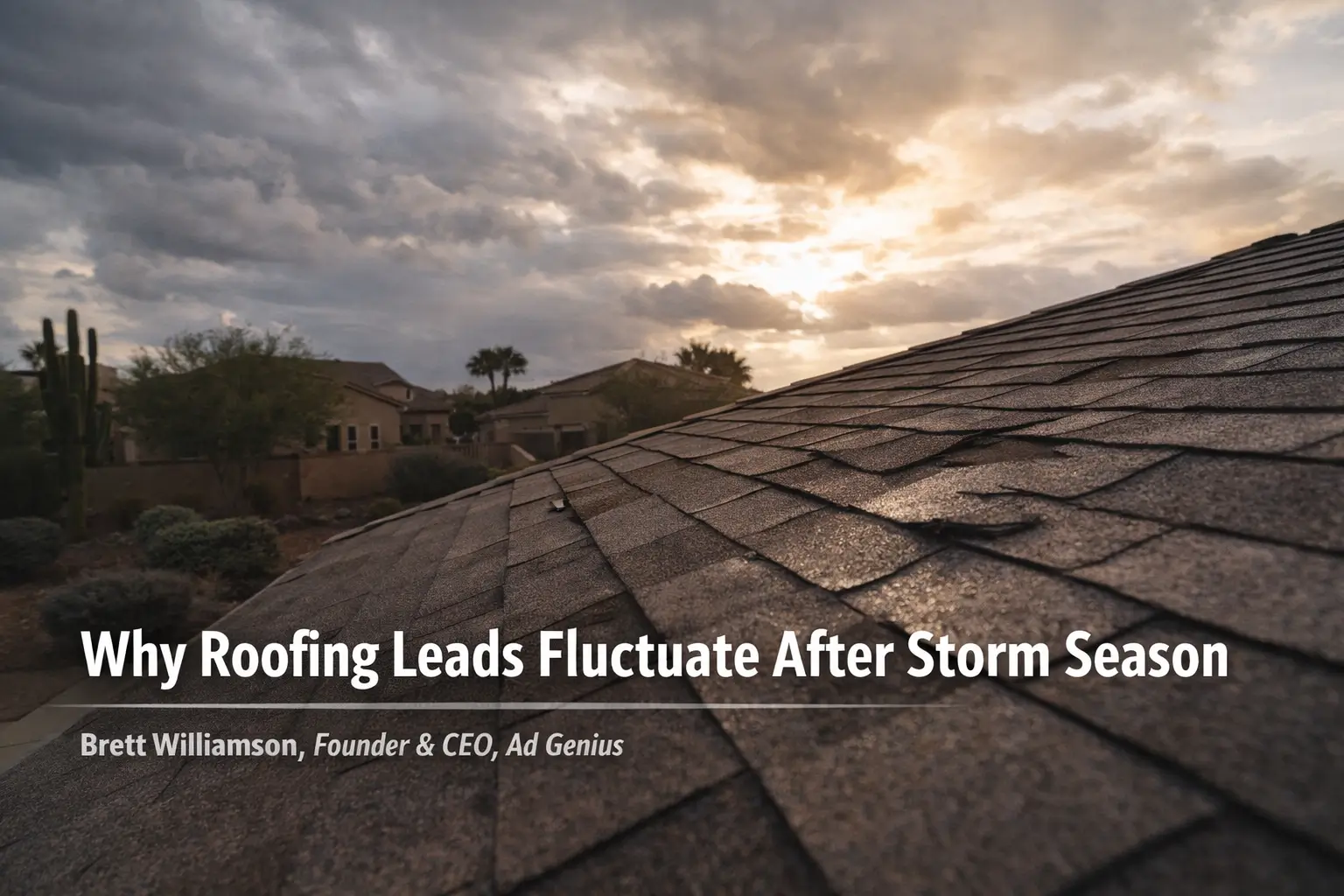
If you run a roofing company, you already know the pattern. A major hailstorm hits your market. The phone rings nonstop for two weeks. Your crews are booked. Inspections are stacked. It feels like growth.
Then it stops.
Three weeks later, the schedule has gaps. Six weeks later, you’re wondering where the leads went. Two months later, you’re staring at an insurance supplement that still hasn’t been approved while your crews need work.
This is the reality of roofing. Demand is volatile. It spikes when the weather is bad, disappears when the weather is good, and the money from storm work often doesn’t land in your account for months after the job is sold. Understanding why this happens, and what to do about it, is the difference between running a business that grows and running one that just survives from storm to storm.
The Storm Cycle Creates an Illusion of Consistent Demand
After a major storm event, roofing search volume in the affected area can double or triple almost overnight. Homeowners search for “roof damage repair near me,” “hail damage roofer,” and “emergency roof leak.” The intent behind those searches is as strong as it gets. These people have visible damage, potential water intrusion, and an urgent need to act.
For roofing contractors positioned to capture that demand, storm season can generate significant revenue in a compressed window. But that’s exactly the problem. It’s compressed. The surge is tied to a weather event, not to the underlying health of your marketing system. When the event passes, the demand doesn’t taper gradually. It drops off a cliff.
The contractors who feel this most acutely are the ones who scaled up during the storm. They hired temporary crews, stretched their operations, and counted on the volume continuing. When it doesn’t, they’re left with overhead they can’t support and a pipeline that dried up faster than they expected.
Storm-driven demand is real demand. But it’s event demand, not system demand. If your marketing infrastructure only captures leads when the weather cooperates, you’re not building a business. You’re chasing weather patterns.
The Insurance Lag: Why Revenue Trails Lead Volume by Months
Even when storm season delivers a flood of leads, the money doesn’t follow quickly. This is the part of the roofing business that contractors understand deeply but rarely see discussed in marketing content. It deserves attention because it directly affects how roofing companies should think about lead generation, cash flow, and growth.
Here’s how the timeline typically unfolds:
A homeowner calls after a storm. You schedule an inspection, identify damage, and help them file an insurance claim. The insurance company assigns an adjuster, who may not visit the property for one to three weeks, depending on the volume of claims in your area. After a major storm, adjusters are managing hundreds of claims simultaneously, and wait times are stretched.
The adjuster inspects, produces a report, and issues an initial estimate. In many cases, that initial estimate doesn’t cover the full scope of work. Shingles are accounted for, but flashing, drip edge, underlayment upgrades, or code-required changes are missing. This is where the supplement process begins.
Your team prepares a detailed supplement request, including documentation, photos, measurements, and line-item justifications. The insurance company reviews it. They may approve it, partially approve it, or push back entirely. That negotiation can take weeks. In complex cases, it takes months. Industry estimates place the typical insurance claim timeline at 60 to 120 days from initial filing to final payment, and that’s when things go relatively smoothly.
Now consider what this means for your business. You generated the lead in April. You inspected the roof in April. But the check might not clear until July or August. In the meantime, you’re carrying material costs, labor, and overhead. And the leads that were flooding in during April? They stopped coming in May.
This is the insurance lag. It creates a cash-flow gap that punishes roofing companies that don’t plan for it. The leads looked great on paper. The revenue shows up on a completely different timeline.
Why the Post-Storm Drop Feels Worse Than It Should
There’s a psychological component to this cycle that compounds the financial one. During the storm surge, everything feels like momentum. The phone is ringing. The CRM is full. Crews are busy. It’s easy to mistake event-driven activity for a healthy business.
When the volume drops, it feels like something broke. But nothing broke. The storm just ended. The organic demand your marketing was capturing before the storm is still there. Homeowners still need roof replacements, leak repairs, and maintenance inspections. But that baseline demand feels invisible after the adrenaline of a storm cycle.
This is where many roofing contractors make reactive decisions that cost them. They either panic and pour money into ads without a strategy, or they pull back entirely and wait for the next storm. Both responses are damaging. The first burns cash. The second guarantees another feast-and-famine cycle.
The contractors who weather this transition well are the ones who built marketing systems before the storm. They had organic search visibility driving retail leads. They had a Google Business Profile generating calls year-round. They had a review profile and a reputation that kept them visible even when the urgency was gone. Storm season was a bonus on top of a foundation, not the foundation itself.
Retail Demand vs. Storm Demand: Two Different Business Models
Every roofing company operates somewhere on a spectrum between retail work and storm/insurance work. Understanding where you sit on that spectrum changes how you should think about marketing.
Storm-driven work is high volume, insurance-dependent, and tied to events you can’t control. The margins can be strong when supplements are approved, but the cash flow is unpredictable, the timeline is long, and the competition during storm windows is intense. Every roofing company in your market is chasing the same homeowners at the same time.
Retail work is steadier. These are homeowners who need a roof replacement because their roof is 20 years old, not because a storm hit last week. They’re comparing contractors based on reputation, price, and professionalism. The sales cycle is different. The decision is more considered. But the revenue is more predictable, the margins are often cleaner, and the work isn’t dependent on weather events.
Most successful roofing companies run both. But the ones that struggle with lead volatility after storm season are usually the ones that over-indexed on storm work and underinvested in the systems that consistently generate retail demand.
The marketing question isn’t “how do I get more storm leads?” It’s “how do I build a system that produces leads regardless of what the weather does?”
This challenge isn’t unique to roofing. It shows up across the home services industry wherever demand is seasonal or event-driven. Learn more about how we approach digital marketing for home service businesses.
What a Stable Lead System Looks Like for a Roofing Company
Stabilizing roofing leads after storm season isn’t about running more ads. It’s about building the infrastructure that keeps demand flowing when the urgency isn’t weather-driven. Here’s what that looks like in practice:
Year-Round Search Visibility
Homeowners search for roofing services every day, not just after storms. Terms like “roof replacement cost,” “best roofing contractor near me,” and “tile roof repair [city]” have consistent search volume year-round. If your website ranks for these terms organically, you’re generating leads regardless of the weather. This requires consistent SEO investment, locally relevant content, and a site that converts visitors into phone calls and form submissions.
For roofing contractors, this is where a focused SEO strategy becomes the stabilizing force that keeps leads flowing between storm cycles.
A Google Business Profile That Works for You Daily
Your GBP is one of the most valuable assets your roofing company owns. It powers your Map Pack visibility, displays your reviews, and gives homeowners the information they need to decide whether to call you. A fully optimized profile with consistent posting, recent photos, accurate service areas, and a strong review average generates leads every single day. During storm season, it captures surge traffic. Between storms, it captures the steady retail demand that keeps the business running.
A Reputation That Sells Before You Pick Up the Phone
A roofing company with 200 reviews averaging 4.8 stars has a massive competitive advantage over one with 30 reviews at 4.2. Homeowners making a $15,000 to $25,000 decision on their roof are going to scrutinize reviews closely. They’re looking for evidence that you show up on time, communicate clearly, handle insurance properly, and do quality work. Your review profile either confirms that or raises doubts. Between storms, when there’s no urgency pushing homeowners to call the first contractor they see, reputation becomes the deciding factor.
Paid Channels That Supplement, Not Replace, Organic Demand
Google Ads and Google Local Services Ads are powerful tools for roofing contractors, but they perform best when they’re layered on top of organic visibility and a strong reputation. Running ads to a weak website or a profile with few reviews burns budget. Running ads to a well-built system amplifies what’s already working. GLSA in particular rewards roofing companies with strong review profiles and fast response times, meaning contractors who invest in reputation management get better placement and lower cost per lead.
Lead Management That Doesn’t Leak Revenue
Storm season exposes weaknesses in lead management that have always been there. When call volume triples, missed calls become missed revenue. But the same principle applies in slow months. If a homeowner calls about a roof replacement in November and no one follows up within 24 hours, that lead is gone. The difference between a roofing company that converts 30% of its leads and one that converts 15% isn’t always the quality of the leads. It’s the quality of the follow-up system.
The Real Cost of Storm Dependence
There’s a broader strategic risk that roofing companies face when they rely too heavily on storm-driven lead generation. It affects hiring, cash reserves, and how the business is perceived in the market.
Crews that get hired during surges and laid off during lulls create turnover costs and quality inconsistency. Cash flow gaps caused by insurance lag force contractors into financing arrangements or delayed payments to suppliers. And homeowners increasingly distinguish between “storm chasers” and “established local roofers.” The contractors who show up only after a hailstorm and disappear six weeks later build a different kind of reputation than the ones who are visible, responsive, and present year-round.
In many markets, municipalities have started implementing anti-solicitation ordinances after storms, restricting door-to-door canvassing for periods ranging from 72 hours to two weeks. Insurance commissioners are increasing scrutiny on storm-market contractors. The regulatory environment is shifting in ways that favor established, year-round operators over transient storm chasers.
Building a marketing system that produces consistent leads isn’t just about revenue stability. It’s about building the kind of business that earns trust, retains good crews, and compounds its reputation over time.
How Ad Genius Helps Roofing Contractors Stabilize Lead Flow
At Ad Genius, we work with established roofing contractors who are tired of the feast-and-famine cycle. Our approach starts with understanding the economics of your business: how storm work and retail work interact, where your cash flow gaps are, and what your marketing infrastructure actually looks like beneath the surface.
We don’t start by selling you ads. We start by diagnosing what’s holding back your lead system. For some roofing companies, it’s a website that hasn’t been updated in years and leaks with every click it gets. For others, it’s a half-built Google Business Profile, a review strategy that doesn’t exist, or a complete lack of organic search visibility for the retail keywords that drive year-round demand.
We build across the full stack: website design and development, SEO, Google Ads, Google Local Services Ads, Meta advertising, Google Business Profile optimization, reputation management, lead management, and brand positioning. The specific combination depends on what the diagnosis reveals and what will have the highest impact for your business right now.
The goal isn’t more leads during the next storm. The goal is a marketing system that keeps your crews working and your calendar full, whether the weather cooperates or not. Learn more about our approach to digital marketing for roofing contractors.
Ready to Build a Lead System That Doesn’t Depend on the Weather?
If you’re an established roofing contractor and you’re tired of watching your pipeline swing from overloaded to empty every season, the first step is a conversation. We’ll look at your market, your competitors, your digital footprint, and your current lead flow, and help you understand what needs to change to stabilize it.
Talk to a marketing strategist at Ad Genius. You’ll speak directly with a strategist, not a salesperson, and leave with clarity on where your marketing stands and what to prioritize next.
Visit adgenius.com/schedule or call (602) 691-7100 to get started.
Best for established roofing contractors ready to build stable, year-round growth.
Frequently Asked Questions
Why do roofing leads drop so sharply after storm season?
Because storm-driven demand is event-based, not systemic. When a hailstorm or windstorm hits, homeowners search urgently for roofers. Once the immediate damage is addressed and the news cycle moves on, that urgency disappears. If your marketing only captures event-driven demand, your leads disappear with it. Contractors with year-round organic visibility and reputation systems experience a much smaller drop because they’re also capturing the steady retail demand that exists regardless of the weather.
How long does the insurance claims process typically take for roofing projects?
Most insurance claims for roof damage take 60 to 120 days from initial filing to final payment. After a major storm, adjuster backlogs can extend that timeline further. Supplement negotiations, where your team requests additional funds for work the initial estimate didn’t cover, add more time. This means a lead generated in April may not produce revenue until July or August, creating a significant cash flow gap that roofing companies need to plan for.
How can a roofing company generate leads outside of storm season?
By investing in the marketing systems that produce retail demand year-round. This includes SEO for terms like “roof replacement [city]” and “tile roof repair near me,” a fully optimized Google Business Profile, a strong, growing review profile, and a website designed to convert visitors into inspection requests. Paid channels like Google Ads and GLSA can supplement organic demand during slower months. The key is to build these systems before the slow season hits, not to react after the leads have already dried up.
What is the difference between storm leads and retail roofing leads?
Storm leads come from homeowners who have responded to recent weather damage. The urgency is high, insurance is usually involved, and competition is intense because every roofer in the market is chasing the same homeowners. Retail leads come from homeowners who need a roof replacement or repair for non-storm-related reasons, such as age, wear, or a planned renovation. Retail leads tend to have a longer decision cycle, are less insurance-dependent, and produce more predictable revenue. Most healthy roofing companies generate both types.
Why does my roofing company struggle with cash flow even when we have a lot of leads?
Insurance claim timelines are the most common culprit. You’ve inspected the roof, filed the claim, and sold the job, but the payment is stuck in the adjuster review and supplement negotiation process. Meanwhile, you’re covering materials, labor, and overhead. This cash flow gap is a structural feature of insurance-driven roofing work, and it’s one of the strongest arguments for building a retail revenue stream that produces faster-paying projects alongside your storm work.
Should I increase ad spend during storm season?
It depends on whether your conversion infrastructure can handle the volume. If your website converts well, your phone gets answered, and your lead follow-up system is tight, increasing ad spend during a storm can quickly capture high-value demand. But if calls go to voicemail, quotes take three days, or your landing pages don’t communicate credibility, the extra spend is wasted. Get the foundation right first, then scale into the surge.
How does reputation affect roofing lead generation between storms?
Between storms, homeowners have more time to compare contractors. There’s no urgency pushing them to call the first name they see. In that environment, your review profile becomes the deciding factor. A contractor with strong, recent reviews and a history of responding professionally to feedback will outperform a competitor with fewer reviews or unaddressed complaints. Reputation management isn’t separate from lead generation. In slower months, it is your lead generation.