Jump to…
Digital marketing works best for established service businesses that already deliver quality work but aren’t visible to their customers when they search. Marketing doesn’t manufacture demand. It captures existing demand that already exists. For home service and professional service businesses competing in saturated local markets, the gap between offline reputation and online visibility is where revenue is being lost. When the foundation is solid and the right channels are applied in the right order, marketing becomes a predictable growth system, not a gamble.
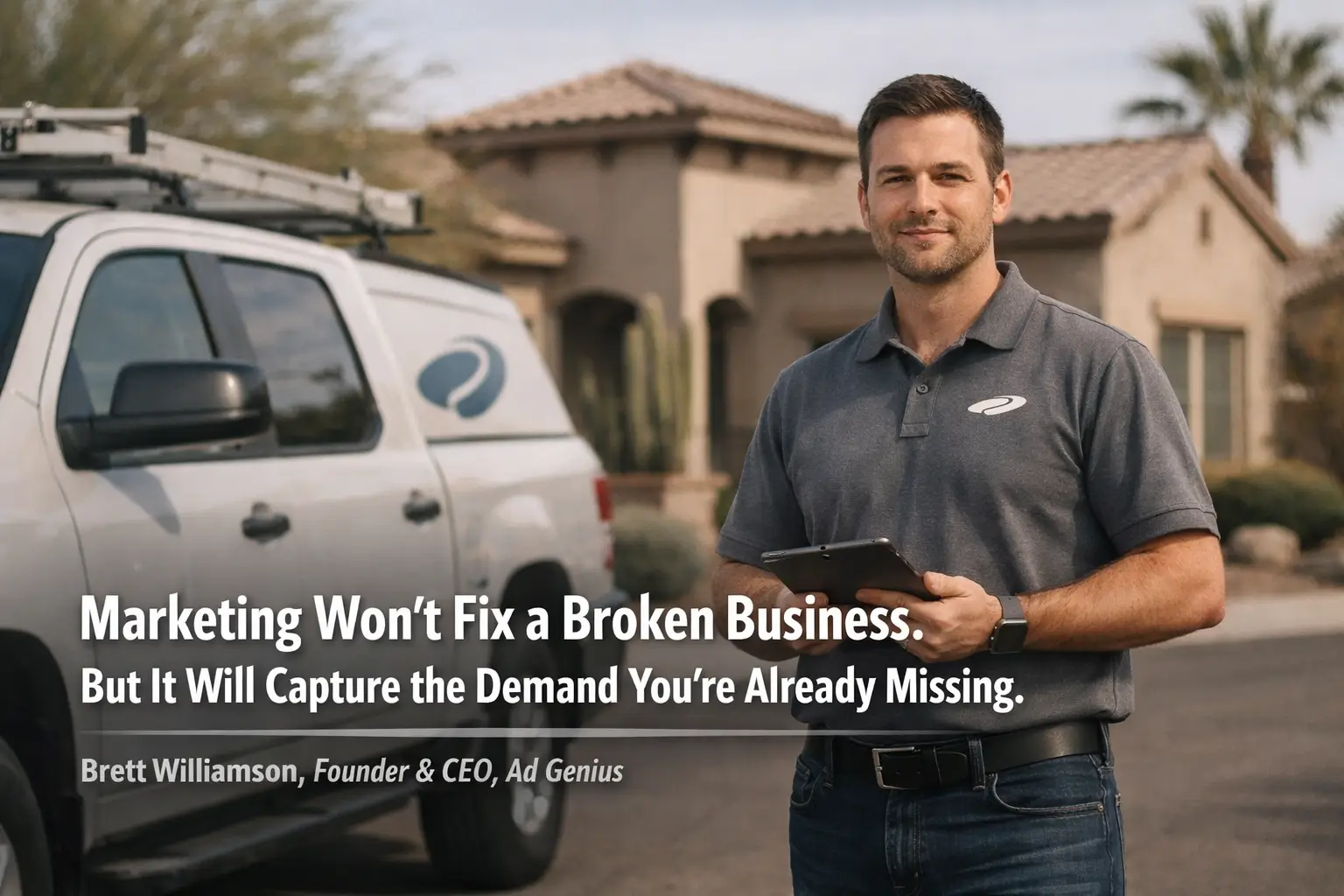
Most marketing agencies won’t tell you this, but it needs to be said: if your business has a service quality problem, a reputation problem, or an operations problem, no amount of advertising will fix it. Marketing will only amplify what already exists. If what exists is broken, you’ll just break faster.
But if you run a solid operation, your customers are happy, your work speaks for itself, and you’re still not getting enough calls? That’s a visibility problem. And visibility problems are solvable.
This guide is written for business owners in the home services and professional services space who are doing the work but not seeing the growth they’ve earned. It explains why that gap exists, how to know if marketing will actually help, and what a well-structured approach looks like when the foundation is already strong.
The Demand Already Exists. You’re Just Not Capturing It.
Every day, homeowners and business decision-makers are searching Google for the exact services you provide. They’re typing in “HVAC repair near me,” “painting contractor in Scottsdale,” or “commercial electrician Phoenix.” These aren’t people browsing casually. These are people with a problem that needs solving and a budget to solve it.
Nearly half of all Google searches carry local intent. That’s billions of daily searches from people looking for something nearby. And when someone searches on their phone for a local service, the vast majority either call or visit a business within 24 hours. This isn’t theoretical demand. This is real revenue, happening right now, going to whichever business shows up first.
If that business isn’t yours, it’s your competitor’s.
For a roofing contractor, that might mean losing a $20,000 re-roof to a competitor who simply had a better Google presence. For a painting company, it could be a $6,000 interior job that went to the first name that appeared in the Map Pack. These aren’t hypothetical losses. They happen every day in every local market.
Why Strong Businesses with Low Visibility See the Best Results
Here’s the pattern we see over and over at Ad Genius. The businesses that get the strongest results from marketing are not the ones trying to use ads to cover up poor reviews or inconsistent work. They’re the ones that already run a tight operation but have simply never invested in being found online.
The math is straightforward. When a business already converts a high percentage of its leads because the service is excellent, every additional lead generated through marketing is worth more. You’re not losing half of them to bad follow-up or a one-star review from six months ago. You’re closing them, delivering, and earning another referral on top of it.
Think about an HVAC company in Phoenix that’s been in business for 15 years. They have a 4.8-star average on Google, their technicians are NATE-certified, and every customer they serve tends to call back for maintenance. But their website was built in 2016, they’ve never invested in SEO, and their Google Business Profile is half-filled out. A competitor with worse service but better visibility is getting the calls. That’s not a quality problem. That’s a marketing problem, and it’s the easiest kind to fix.
The return on marketing investment for businesses in this position tends to be strong and sustainable. Not because of some magic number a blog post can promise you, but because the fundamentals are already working. When you combine a proven service with consistent visibility, the results compound. Marketing doesn’t replace good business. It rewards it.
How to Know If Marketing Will Actually Work for Your Business
Not every business is in a position to benefit from a marketing investment right now. Before spending a dollar, it’s worth an honest assessment of where things stand. Here are the indicators that tell us a business is in a strong position to see real returns:
Your Customers Already Trust You
You get referrals. Your reviews are strong. When someone does find you, they tend to hire you and come back. If that’s your reality, the hard part is already done. Marketing just needs to put you in front of more people like the ones you’re already serving well.
You Have the Capacity to Take On More Work
Generating 40 new leads a month doesn’t help if your crews are already booked out six weeks. The businesses that benefit most have room to grow without their quality slipping. If you’ve got crews sitting idle or a calendar with gaps you need to fill, that’s exactly the kind of problem marketing can solve.
Your Online Presence Doesn’t Match Your Reputation
This is the clearest signal. You know you do great work. Your customers tell you constantly. But when someone Googles your service in your market, you’re not showing up. That gap between what your customers know about you and what Google shows about you is where revenue is being left on the table.
People Are Actively Searching for What You Do
In home service industries, this is almost always true. Homeowners search for HVAC repair, roof replacement, interior painting, and electrical work every single day. In professional services, prospects search for financial advisors, attorneys, and consultants by specialty and location. If there’s search volume for your service in your market, there’s demand waiting to be captured.
When Marketing Will Not Fix the Problem
This part matters just as much. If the business has underlying issues, investing in marketing will only make them more visible. More leads flowing into a broken system means more unhappy customers, more negative reviews, and a faster decline.
Here are the red flags:
Your average review is below 4.0 stars, and the negative reviews highlight consistent problems. You struggle to meet timelines, maintain quality, or communicate effectively. Your pricing is significantly out of step with your market, and you can’t articulate why. You don’t have a reliable process for answering calls, following up on leads, or getting quotes out quickly. Your service itself has unresolved quality issues.
We’re direct about this at Ad Genius. If a prospective client comes to us and the real issue is operational, we’ll say so. Investing in marketing before fixing the foundation is like running ads for a restaurant with a health code violation. Fix the kitchen first.
What Capturing Missed Demand Actually Looks Like
When a strong business builds the right marketing system, results tend to follow a predictable pattern. Here’s how it works in practice, channel by channel:
Local SEO and Google Business Profile: Owning the Map Pack
When someone searches “electrical contractor near me” or “HVAC company Phoenix,” Google shows a map with three local businesses at the top of the results. This is the Map Pack, and it’s one of the most valuable positions in all of local marketing. Roughly four out of ten local searchers click on a Map Pack result. If your business isn’t showing up there, your competitor is getting those calls.
Earning that position requires a fully optimized Google Business Profile, consistent business information across directories and citations, a steady flow of authentic reviews, and locally relevant content on your website. None of this happens by accident, and none of it happens overnight. But once you earn that visibility, it becomes a durable asset that drives leads without ongoing ad spend.
SEO: Ranking for the Searches That Drive Revenue
Beyond the Map Pack, the organic search results capture the rest of the local intent traffic. The key is targeting the specific terms your customers actually type into Google. Not broad vanity keywords, but the service-plus-location combinations that signal someone ready to buy.
A painting contractor in Phoenix doesn’t need to rank for “painting.” They need to rank for “exterior house painting Phoenix,” “cabinet painting Scottsdale,” and “commercial painting contractor Mesa.” Each of those terms represents a customer with a specific need and a budget. SEO builds visibility for those searches over time, and unlike paid ads, the results continue working long after the initial investment.
Google Ads and GLSA: Capturing High-Intent Demand Immediately
SEO takes time. Google Ads and Google Local Services Ads fill the gap by putting your business at the top of results right now. When a homeowner searches “emergency AC repair near me” at 2:00 PM in July, they’re not browsing. They need help today. Google Ads ensures you’re the first result they see.
GLSA takes it a step further. These are the “Google Guaranteed” listings that appear above even standard paid ads. For home service businesses, the trust signal of that badge is significant. GLSA also operates on a pay-per-lead model rather than pay-per-click, which means you only pay when a real prospect contacts you. Your review profile, response time, and proximity all influence your placement, which ties directly back into reputation management and GBP optimization. These channels feed each other.
Meta (Facebook) Ads: Building Awareness Before the Search
Google captures people who are already searching. Meta creates awareness among people who fit your ideal customer profile but haven’t started searching yet. For a roofing contractor, that might mean targeting homeowners in specific ZIP codes whose homes are 20+ years old. They haven’t searched for “roof replacement” yet, but they’re a prime candidate for it.
Meta is also powerful for retargeting. A homeowner visits your website after a Google search, doesn’t call, and then sees your ad in their Facebook feed three days later. That repetition builds familiarity and trust. The important nuance is that Meta leads tend to be earlier in the buying cycle than search leads, so the follow-up process needs to reflect that. A homeowner who clicks a Facebook ad is not in the same mindset as someone who searched “AC replacement quote today.” Lead management systems need to account for the difference.
Website Design: The Conversion Engine Everything Else Depends On
Every channel listed above drives traffic to your website. If it loads slowly, looks outdated, or makes it hard to call or request a quote, every dollar spent on SEO, ads, and reputation management is diminished.
For a home service business, the website has three jobs: prove you’re legitimate, prove you serve their area, and make it effortless to take the next step. A painting contractor with a strong Google presence and a website that looks like it was built in 2012 is leaking revenue every single day. The site isn’t a brochure. It’s the closer.
Reputation Management: The Silent Closer
A business with 150 reviews averaging 4.8 stars doesn’t need to convince anyone that they do good work. The reviews do that before the first phone call ever happens. Reputation management means consistently building that body of evidence, responding to every review (positive and negative), and ensuring your reputation is visible across the platforms that matter.
It also feeds directly into GLSA eligibility and Map Pack rankings. A business with weak reviews will struggle to compete in local search regardless of how well their SEO is executed. Reputation isn’t separate from marketing. It is marketing.
Lead Management: Where Most Revenue Leaks
This is the piece most agencies ignore, and it’s often where the biggest gains are hiding. It doesn’t matter how many leads your marketing generates if calls go unanswered, follow-ups take three days, or quotes sit in someone’s inbox. For a contractor with two crews, a missed call on a busy Tuesday morning could cost a $15,000 job to the competitor who answered.
Lead management means having systems to capture, route, track, and follow up on every inquiry, and knowing which leads came from which channels so you can measure what’s actually working.
The Compounding Effect: Why the Right Marketing System Gets Stronger Over Time
One of the most important things to understand about digital marketing, especially SEO and content, is that results compound over time. Paid advertising stops producing the moment you stop paying. Organic visibility, a strong review profile, and a well-built website continue working for you month after month.
Most SEO campaigns begin showing meaningful traction within six to twelve months. But peak performance typically comes in year two or three. The investment you make today doesn’t just pay for itself. It continues to generate returns long after the initial work is done.
Every review earned, every page of locally relevant content published, and every citation built adds another layer of visibility that your competitors have to work harder to overcome. Businesses that commit to this approach find their cost per lead decreasing over time while volume increases. That’s the compounding effect, and it’s the fundamental reason long-term marketing investment outperforms one-off campaigns.
How Ad Genius Approaches This Differently
Most marketing agencies will take anyone’s money and start running ads on day one. We take a different approach because we’ve learned that tactics without strategy waste budgets and erode trust.
Our process starts with a diagnosis. We look at your local market, analyze where competitors rank and advertise, assess your current digital footprint, and identify where demand exists for your specific services. Before we recommend a single channel or tactic, we answer one question: what’s actually holding growth back?
From there, we prioritize. Not every business needs every channel at once. An HVAC contractor with a strong reputation but no search visibility has different priorities than a painting company with a dated website and no review strategy. The order of operations matters. Visibility before amplification. Credibility before traffic. Conversion before scale.
Then we execute. Our team works across website design and development, SEO, Google Ads, Google Local Services Ads, Meta (Facebook) advertising, Google Business Profile optimization, reputation management, lead management, and brand positioning. The specific combination depends on what the diagnosis reveals and what the business is ready for.
Every engagement includes transparent reporting so you can see what’s working, what’s improving, and how the investment is performing. We don’t hide behind vanity metrics. We measure what matters: calls, leads, quotes, and revenue.
Ready to See Where You Stand?
If your business delivers great results but your phone isn’t ringing enough, the issue probably isn’t your business. It’s your visibility. The customers are already searching. The demand already exists. You just need to show up where they’re looking.
Talk to a marketing strategist at Ad Genius. We’ll walk through your competitive landscape, show you where your competitors are showing up, identify the demand that exists in your market, and help you understand what it would take to start capturing it.
Visit adgenius.com/schedule or call (602) 691-7100 to get started.
Best for established businesses ready to invest in growth.
Frequently Asked Questions
How do I know if my business is ready to invest in marketing?
Your business is ready if you have a proven service that customers consistently value, the capacity to handle additional work without quality dropping, and an online presence that doesn’t reflect your actual reputation. If your reviews are below 4.0 stars or you have unresolved operational issues, it’s better to address those first. Marketing amplifies what already exists, so the foundation needs to be solid.
How long does it take to see results from SEO?
Most local SEO campaigns begin showing measurable traction within six to twelve months. Early indicators like improved rankings and increased organic traffic often appear sooner. Peak performance typically comes in year two or three as content, reviews, and authority compound. This is why SEO works best as a long-term strategy rather than a short-term experiment.
What is the Google Map Pack and why does it matter?
The Map Pack is the block of three local business listings that appears at the top of Google when someone searches for a local service. It’s one of the highest-value positions in local marketing because it captures a large share of clicks from high-intent searchers. Earning a Map Pack position requires an optimized Google Business Profile, consistent business information across the web, strong reviews, and locally relevant website content.
What is the difference between SEO, Google Ads, and Google Local Services Ads?
SEO builds organic visibility over time so your business appears in search results without paying per click. Google Ads places your business at the top of results immediately on a pay-per-click basis, capturing demand from people searching right now. Google Local Services Ads appear above even standard Google Ads and carry a “Google Guaranteed” badge. GLSA operates on a pay-per-lead model, and your placement is influenced by reviews, responsiveness, and proximity. Most businesses benefit from a combination of these channels, applied in the right order.
Do I need a new website to get results from marketing?
Not always, but often. If your website loads slowly, looks outdated, lacks clear calls to action, or doesn’t quickly convey credibility, it will limit the performance of every other channel. Every ad click, every search result, and every referral eventually leads to your website. If the site doesn’t convert visitors into leads, the investment in driving traffic is partially wasted.
How does Ad Genius decide which channels to recommend?
We start with a diagnosis, not a pitch. Before recommending any channel, we assess your current digital footprint, competitive landscape, reputation, website, and visibility. The right combination of channels depends on what’s holding growth back and what the business is ready for. Some businesses need visibility first. Others need conversion infrastructure. The order of operations determines the results.
Can marketing help if my competitors are already dominating online?
Yes, and this is actually one of the most common situations we work with. The fact that competitors are visible online confirms that demand exists in your market. The question is whether your business is positioned to capture its share of the market. Competitive markets require a more deliberate strategy, but the opportunity is real. The businesses that commit to a system-based approach consistently gain ground.
What makes Ad Genius different from other marketing agencies?
We start with clarity, not channels. Most agencies lead by selling SEO packages or ad campaigns. We lead by diagnosing what’s broken, what’s missing, and what should be addressed first. We work specifically with established home service and professional service businesses, and our approach is built around a clear order of operations: diagnose, prioritize, execute. Marketing works best when it’s treated as a system, not a collection of disconnected tactics.