Jump to…
Ad Genius | Research Series | No. 03
What HVAC Customers Actually Do Before They Call
Brett Williamson, Founder & CEO of Ad Genius | adgenius.com
The findings in this piece draw on primary research from ACHR News and Clear Seas Research (400+ HVAC homeowners, 2024), BrightLocal Local Consumer Review Survey (1,002 US adults, 2026), Housecall Pro homeowner survey (1,040 US adults, 2025), FIELDBOSS homeowner survey (2025), and the 2025 Web Almanac (HTTP Archive, CrUX field data, 18+ million origins). All sources were audited for conflicts of interest before use. Sources with active contractor lead generation funnels were excluded.
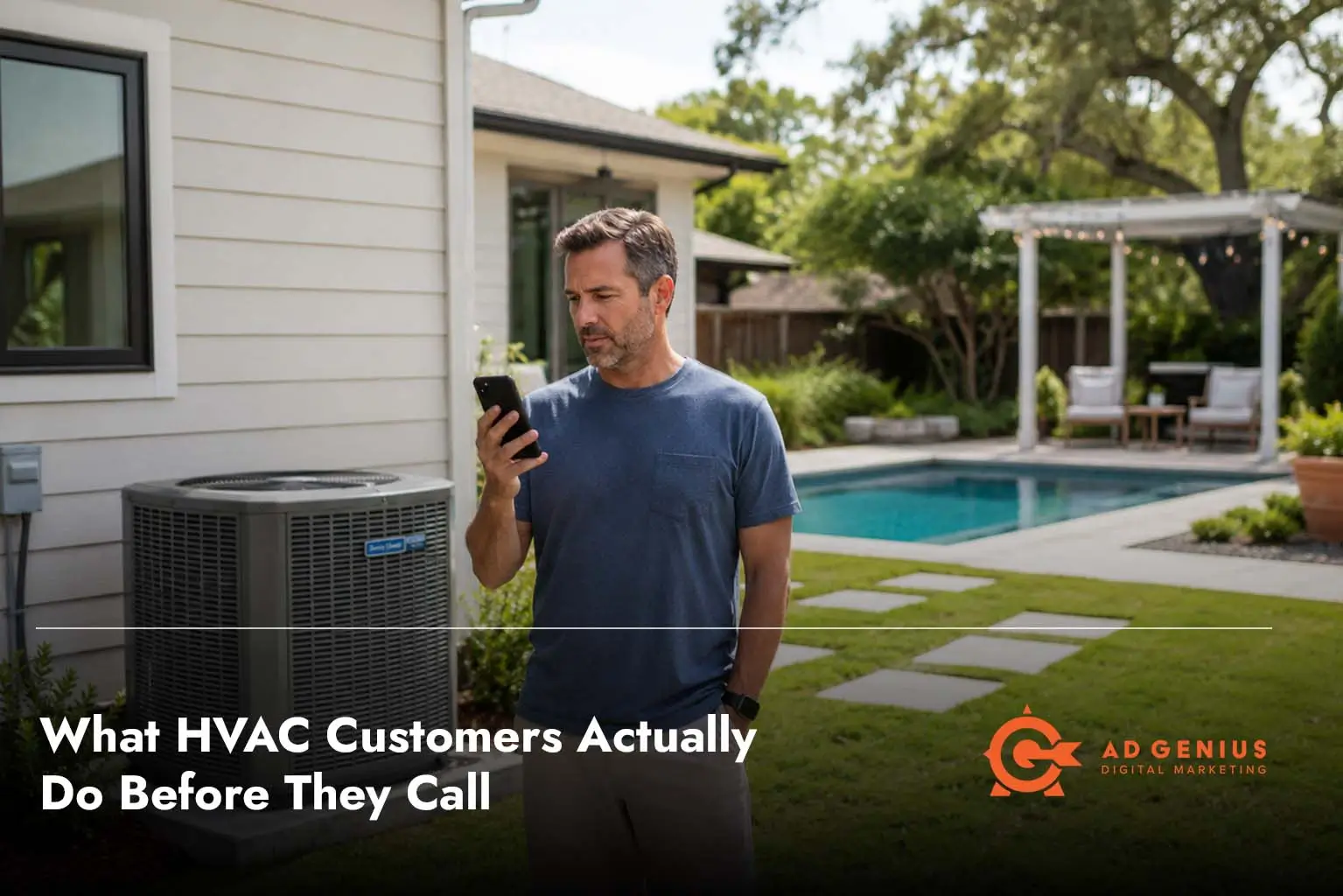
The phone call is not where the buyer journey begins. By the time an HVAC homeowner calls your office, they have already searched, read reviews, visited at least one website, and in a growing number of cases, asked an AI platform for a recommendation. The call is the end of a sequence that most contractors never see and fewer still have built for.
This piece maps that sequence. Not as a theoretical framework, but as a documented pattern of behavior drawn from primary research across multiple homeowner studies. Every touchpoint in this sequence is an opportunity to win the job before you ever speak to the customer. Every gap in it is a place where the job goes to someone else.
At a Glance
69%
of HVAC homeowners choose a contractor they have used before or were referred to. Nearly all of them still validate online before calling.
91%
of HVAC homeowners consider online reviews an important factor in contractor selection.
ACHR News / Clear Seas Research, 2024
47%
of consumers will not contact a business with fewer than 20 reviews.
BrightLocal, 2026
31%
of consumers will only use a business rated 4.5 stars or higher, up from 17% just one year earlier.
BrightLocal, 2026
54%
of consumers visit a contractor’s website after reading a positive review.
BrightLocal, 2026
97%
of homeowners expect to find transparent pricing before deciding to hire.
Housecall Pro, 2025
70%
of HVAC homeowners are more likely to call a contractor who shows pricing on their website. Only 31% of contractors do.
ACHR News / Clear Seas Research, 2024
48%
of mobile websites fail all three Google Core Web Vitals. Most contractor websites perform worse than that benchmark.
6➞45%
growth in consumers using AI tools for local business recommendations, in a single year.
BrightLocal, 2026
Where Most Customers Come From, and What That Actually Means
Start with a number that looks like a loyalty story: 69% of HVAC homeowners who hired a contractor in the past year chose one they had used before or were referred to by a friend or family member. That is from FIELDBOSS’s 2025 homeowner survey. The same pattern appears in ACHR News research, which found 67% of homeowners report finding their HVAC contractor through word-of-mouth or recommendation, now defined broadly enough to include social media groups and online forums.
At first read, this looks like an argument for investing in customer retention and asking for referrals. And it is. But it is also something else.
It is the setup for a misread that costs contractors real money. The misread goes like this: because most customers come from prior relationships or referrals, online presence matters less. The phone will ring because the work is good and the community knows it.
The data does not support that assumption. What it actually shows is that referral is the entry point, not the destination. The referral tells a homeowner who to look up. What they find when they look determines whether they call.
ACHR News and Clear Seas Research surveyed more than 400 HVAC homeowners in 2024. Of those homeowners, 91% said online reviews were an important factor in choosing an HVAC contractor. That is not 91% of homeowners who found the contractor through a search. That is 91% of HVAC homeowners, the same population where 69% came from referral or prior experience.
The referral does not close the sale. It opens a browser tab.
Two contexts, one sequence
The pre-call journey runs differently depending on what triggered it. A homeowner whose air conditioner stops working on a July afternoon is not comparison shopping. They are searching on their phone, reading the first few reviews they see, and calling whoever answers. The sequence is compressed but it is still the same sequence: search, review check, website visit, call.
A homeowner considering a system replacement because their equipment is fourteen years old and efficiency is slipping is running a longer version of the same journey. Multiple search sessions. Multiple review reads. Website visits to two or three contractors. Possibly a conversation with a neighbor or a post in a neighborhood Facebook group. In the replacement context, the research window can span days or weeks.
The maintenance customer is largely loyalty-driven. If they are already in a service agreement with a contractor, that relationship short-circuits most of the sequence. The contractor already has the next call. This is the operational case for maintenance agreements that most contractors undervalue: they do not just produce recurring revenue. They remove the homeowner from the pre-call journey entirely.
The replacement customer is a different profile. They are often deciding for the first time, or switching from a prior contractor whose pricing, communication, or response time left them open to reconsidering. This is where the pre-call sequence does its most consequential work, and where being findable, credible, and transparent in writing produces the most return.
The Search Phase
Whatever triggers the need, search is where most homeowners begin their research. For the emergency caller, it is a single urgent query on a phone. For the replacement buyer, it is a series of queries across multiple sessions, often combining general HVAC research with contractor-specific lookups.
Seasonal Search Demand
AC repair searches, Feb → July peak
+266%
Emergency-intent searches (“emergency AC repair near me”) during hot weather
+400%
Local-intent modifiers (“near me,” city name) vs. generic queries
+15–20% conversion
These are not leads that browse. They are leads that call whoever appears first and looks credible.
The demand patterns reflect this. AC repair searches surge approximately 266% from February to their July peak. Furnace repair dominates January. Searches flagged as emergency intent, such as ’emergency AC repair near me,’ spike close to 400% during hot weather. These are not leads that browse. They are leads that call whoever appears first and looks credible.
Local intent modifiers, the ‘near me’ and city-name searches, consistently convert at 15 to 20% higher rates than generic HVAC queries. The homeowner has already narrowed their criteria to proximity. What they are now evaluating is credibility.
Mobile is where most of this search happens. For home services, 71% of web traffic comes from mobile devices, driven by the local-intent searches that dominate the category. Across our active client accounts, we consistently see that number at 86%. Emergency searches are virtually always mobile. Even a replacement buyer doing deliberate research will return to their phone repeatedly through the process.
This has direct implications for how contractors appear in search, which is covered in the website section below. For now, the point is simpler: the first place most homeowners look is Google, they look from their phones, and what they see in the first few results is what determines who gets considered.
What Reviews Are Actually Doing
Your community cares more about what a stranger says about you than what you say about you.
That is not a positioning statement. It is a description of documented consumer behavior. In the 2026 BrightLocal Local Consumer Review Survey, which covered 1,002 US adults, 97% of respondents said they read reviews for local businesses. Among HVAC homeowners specifically, ACHR News and Clear Seas Research found that 91% rate reviews as an important factor in contractor selection.
Neither of those numbers requires interpretation. They simply mean that when a homeowner is deciding who to call, other customers’ words carry more weight than the contractor’s own messaging. The contractor’s website, ads, and social posts are all secondary to what the review profile shows.
The Floor is Rising
The standards for what constitutes an acceptable review profile have moved sharply in the past year.
BrightLocal’s 2026 data shows that 31% of consumers will only use a business with 4.5 stars or higher. One year earlier, that figure was 17%. That is nearly a doubling in twelve months. At the same time, 68% now require at least 4 stars before they will consider a business, up from 55% in 2025. And 47% will not contact a business that has fewer than 20 reviews.
A business that has operated for a decade but carries a thin or stale review profile is not just losing marginal consideration. It is being disqualified by nearly half of all prospective customers before a single word is exchanged. The revenue loss that flows from that disqualification compounds across every year the profile stays thin. A business owner who has not built this does not see the loss because the calls that never happened do not show up in any report.
Review Standards, Year Over Year
Consumers requiring 4.5+ stars
Up from 17% one year earlier
31%
Consumers requiring 4+ stars
Up from 55% in 2025
68%
Won’t contact a business with fewer than 20 reviews
47%
A business with a thin or stale review profile isn’t losing marginal consideration — it’s being disqualified by nearly half of prospective customers before a word is exchanged. The losses compound every year the profile stays thin, and never show up in any report.
Volume matters more than perfection
Consider the buyer psychology at work when a homeowner is evaluating two contractors: one with 17 five-star reviews, one with 419 reviews averaging 4.8 stars.
17 reviews, 5.0 avg.
419 reviews, 4.8 avg.
The 17-review profile reads as curated. Seventeen people could be family members, friends, or the handful of customers the owner specifically asked after great jobs. The perfect score reinforces that suspicion rather than resolving it. Research from Northwestern University’s Spiegel Research Center found that ratings between 4.2 and 4.5 stars often outperform perfect scores in consumer trust, because the non-perfect result signals a real, unfiltered sample.
The 419-review profile at 4.8 reads as earned. A handful of less-than-perfect reviews in a large dataset does not signal failure. It signals volume and authenticity. The homeowner sees a business that has done the work many times, heard from real customers at scale, and maintained a strong record across all of it. That is what trust looks like.
Review velocity and the recency problem
Volume alone is not sufficient. BrightLocal’s 2026 data found that 74% of consumers only trust reviews written in the last three months. A contractor who built a strong review profile two years ago and stopped asking has a degrading asset. The reviews that mattered in 2023 are invisible to the homeowner searching today.
Review Response Behavior
HVAC contractors who don’t respond to reviews at all
Consumers more likely to use a business that responds to all reviews
The 2024 ACHR News data found that 43% of HVAC contractors do not respond to reviews at all. This is a compounding problem. BrightLocal data shows that 80% of consumers are more likely to use a business that responds to all reviews. A non-response to a negative review does not look neutral. To the homeowner reading it, it looks like the contractor does not care or does not know the review exists.
You have not, because you ask not
The principle is simple: reviews are not a passive outcome of good work. They are an active result of asking. The contractors who build 400-review profiles do not build them accidentally. They build them by asking, specifically, at the right moment, in person.
The right moment is at the point of service, before the technician leaves the job site. A face-to-face ask from a technician who just delivered good work converts at a meaningfully higher rate than a follow-up text or automated email sent three days later. Post-sale automation has a role in review programs, but it cannot carry the program on its own. The ask that produces the review happens in the driveway, not in a drip sequence.
Where Homeowners Check Reviews
56%
Contractor’s own website
51%
Yelp
43%
36%
Angi
32%
Where homeowners go when they do look for reviews: 56% check Google first, and 51% check the contractor’s own website. ACHR News research also found homeowners use Yelp (43%), Facebook (36%), and Angi (32%). The 2026 BrightLocal data shows consumers now consult an average of six review platforms before making a decision on a local business. A single strong Google profile is necessary but no longer sufficient as the only place reviews exist.
The Website Visit
BrightLocal’s 2026 research found that after reading a positive review, 54% of consumers visit the contractor’s website as their next action. That number was 32% when BrightLocal asked the same question in 2019. The website is no longer a supplemental touchpoint. It is where the sale moves from consideration to decision.
What Homeowners Expect from a Contractor Website
A professional, user-friendly website
96%
Transparent pricing before deciding to hire
97%
Factor in availability of online booking
80%
More likely to call a contractor whose site shows pricing
70%
Contractors who actually show pricing on their site
31%
Housecall Pro (2025) and ACHR News / Clear Seas Research (2024). The gap between what homeowners expect and what contractors provide is the single clearest opportunity in this entire piece.
Housecall Pro surveyed 1,040 US homeowners in 2025. Ninety-six percent said they expect a professional, user-friendly website from any home service contractor they consider, across all age groups. Ninety-seven percent said they expect transparent pricing before deciding to hire. Eighty percent factor in the availability of online booking when deciding on a contractor.
ACHR News and Clear Seas Research found the pricing gap directly: 70% of HVAC homeowners are more likely to call a contractor whose website shows pricing. Only 31% of HVAC contractors surveyed had any pricing on their site, though that figure is up from 20% in prior years.
The consumer logic is not complicated. Homeowners estimate mortgage payments on Zillow before calling a lender. They check menu prices before choosing a restaurant. They have been trained by every other category of purchase to expect price information before committing to a conversation. When a contractor website says nothing about pricing, the homeowner reads it one of two ways: the contractor does not want to compete on price, or the contractor does not want to be compared. Neither reading builds trust.
Where most contractor websites fail
The website visit happens almost entirely on a phone. For home services, 71% of web traffic comes from mobile devices, driven by the local-intent searches that dominate the category. Across our active client accounts, we consistently see that number at 86%. Emergency searches are virtually always mobile. Even a replacement buyer conducting deliberate research will repeatedly return to their phone throughout the process.
Google measures website performance through three Core Web Vitals: how fast the main content loads (Largest Contentful Paint), how stable the page is as it renders (Cumulative Layout Shift), and how quickly it responds to taps and clicks (Interaction to Next Paint). The 2025 Web Almanac, which analyzed field data from more than 18 million website origins using Chrome user experience data, found that only 48% of mobile websites pass all three. Desktop pass rates are better, at 56%. That gap is why most contractors believe their websites are performing. They are checking the wrong screen.
Core Web Vitals – Pass Rate, All Three Metrics
Desktop
Mobile (where the visit actually happens)
WordPress sites specifically, mobile
Most contractor websites run on WordPress and are built with page builders such as Divi, Elementor, and Avada. These tools prioritize visual flexibility, and that flexibility carries a performance cost. Rendering frameworks, plugin dependencies, and unoptimized assets are the primary drivers of mobile load failures. WordPress sites meet Core Web Vitals on mobile at a rate of 46%, slightly below the web average, according to the same Web Almanac data. The most commonly failed metric is Largest Contentful Paint, which measures how long a visitor waits before the main content appears. Only 62% of mobile pages achieve an acceptable LCP score globally. For sites carrying large hero images, multiple plugins, and no caching layer, that number falls further. More performance-oriented builders, such as Bricks Builder, exist and deliver meaningfully better results, but they require greater technical expertise to implement and remain uncommon in the contractor space. That is part of why the gap between what most contractors have and what is achievable on mobile performance is wider than it needs to be.
In our own audits of contractor websites, the pattern holds without exception: a site that presents well on a desktop in an office fails on a phone in a homeowner’s driveway. The scores look different. The contractor never sees the mobile experience their customers see. Google’s March 2026 core update tightened LCP thresholds and moved to site-wide performance scoring, meaning slow pages now drag rankings across the entire domain, not just the pages that fail individually.
+32%
increase in the probability of a mobile visitor leaving without acting as load time rises from 1 to 3 seconds. Most contractor homepages take longer than that.
Google PageSpeed / Core Web Vitals research
A mobile-optimized website is not a design preference. It is the difference between capturing the referral and losing it.
Comparison Shopping and the Quote Decision
ACHR News and Clear Seas Research asked homeowners how many quotes they planned to get before choosing an HVAC contractor. Sixty-three percent said three. Twenty-nine percent said two. Most homeowners are planning to shop.
But intention and behavior are different things. According to a Lennox study cited by Chris Hondl of Nexstar Network in ACHR News, 55% of consumers ultimately get only one quote. The gap between stated intention and actual behavior closes when trust is established early. A homeowner who reads a strong review profile, visits a transparent website, and sees pricing context before calling has already answered most of their own evaluation questions. The call, for them, may already be a decision rather than a comparison.
68%
of homeowners will seek additional quotes if the initial price comes in higher than expected.
Housecall Pro, 2025
That number explains why pricing transparency is not just a discovery tool. It is conversion protection. A homeowner who arrives at the call with a realistic price expectation, formed from the website visit, is less likely to experience sticker shock. A homeowner who has no pricing context, and hears a number that exceeds their mental model, goes looking for comparison. Seventy percent of homeowners told ACHR News they are more likely to call a contractor who posts pricing. The thirty percent who said it makes no difference are already decided. The sixty-eight percent who will seek additional quotes when surprised are the ones pricing transparency is designed to protect.
The replacement context extends this. A homeowner considering a $10,000 to $15,000 system replacement is not going to commit to one company based on a single interaction. They are going to do multiple website visits, read reviews more carefully, and possibly ask for two or three quotes. This is where depth of content, consistency of review volume, and clarity of pricing work together to establish preference before the first call. The contractor who wins the replacement job is often the one the homeowner has already decided to trust by the time they pick up the phone.
AI as the New Intermediary
Consumers using AI tools for local business recommendations
2025
2026
In 2025, 6% of consumers reported using AI tools to find local business recommendations. In 2026, that figure is 45%. BrightLocal’s Local Consumer Review Survey, which has tracked this question using a consistent methodology, documented the largest one-year shift in consumer discovery behavior since the survey’s inception.
That is not a gradual trend. That is a channel rewriting itself in twelve months.
AI search does not return a list of ten results. When a homeowner asks ChatGPT or Google AI Mode who to call for HVAC service in their city, the response names one or two businesses. Contractors who appear in those answers are not necessarily the largest or highest-spending in the market. They are the ones whose digital presence gives AI platforms enough structured, credible, and consistent information to cite with confidence.
The adoption gap
Most contractors have moved quickly on using AI internally. Scheduling tools, automated communication, call summaries, review drafts. That adoption is real and the operational benefits are genuine.
AI Adoption – Operations VS. Discovery
Contractors who’ve tried AI tools
Housecall Pro, 2025 AI Adoption in Home Services (400+ contractors)
70%+
Contractors actively using AI tools in their business
~40%
Nearly all of that adoption is operational — scheduling, invoicing, call handling, follow-up automation. Optimization for AI-driven discovery is a different discipline entirely, and very few contractors have built for it.
Housecall Pro’s 2025 AI Adoption in Home Services report, which surveyed more than 400 contractors across the US, found that over 70% have tried AI tools and roughly 40% use them actively in their businesses. The tools they are using are operational: scheduling, invoicing, call handling, follow-up automation. That is a different problem from the one this piece describes.
Optimization for AI-driven discovery is a different discipline. It requires structured on-site content that answers the questions AI platforms use as source material, consistent business information across every directory and platform the AI indexes, review signals that mention specific services and locations rather than generic praise, and third-party citations that establish the business as a recognized authority in its trade and geography. That is not a plugin or a software subscription. It is a content and authority build that takes months and compounds over time.
The contractors who begin that build now will have structural advantage over those who wait. AI platforms reinforce what they already recognize. Early movers accumulate citations that make them more likely to be cited again. The window where this advantage is available without significant competition is closing.
The contractors working with partners who understand this distinction between AI adoption for operations and AI optimization for discovery are building a position that will be difficult to displace. Most contractors have the former. Very few have the latter.
What This Means
The pre-call journey is not chaotic. It follows a sequence. That sequence runs through a search query, a review check across multiple platforms, a website visit that happens mostly on a phone, and increasingly through an AI platform that names one or two businesses and moves on. By the time the homeowner calls, they have already formed an opinion.
The contractors who understand this build deliberately for each step. They treat reviews as an operational discipline that requires a face-to-face ask, not a post-sale automation. They build websites that load on a phone in under three seconds, show pricing context, and make the next step obvious. They publish content that AI platforms can find and cite. They operate maintenance agreements that keep past customers from ever entering the sequence as new buyers.
The contractors who do not build for this assume the phone will ring because the work is good and the community knows it. It will ring sometimes. But the referred homeowner who hit a slow website at nine in the evening and moved on to the next result, or the replacement buyer who disqualified a contractor based on seventeen stale reviews, or the emergency caller who asked ChatGPT and got a different name, those do not show up anywhere. The losses are invisible, and they compound every year.
The sequence runs whether or not you have built for it. The question is whether your business is positioned at each step, or absent from it.
About the Author
Brett Williamson is the Founder and CEO of Ad Genius, a Phoenix-based digital marketing agency serving established home service contractors. Ad Genius works with HVAC operators in the $750K to $8M revenue range who want a marketing partner that diagnoses before prescribing.
Sources
- ACHR News / Clear Seas Research (BNP Media) — Contractor Pro Homeowner Series 2024. Primary research, 400+ HVAC homeowners. achrnews.com/contractor-pro-2024
- ACHR News / Clear Seas Research — “91% of Homeowners Rely on Online Reviews Before Picking Contractors.” September 2024. achrnews.com/articles/155206
- ACHR News / Clear Seas Research — “HVAC Customers and Contractors at Odds With Online Pricing.” December 2024. achrnews.com/articles/163836
- ACHR News / Clear Seas Research — “How To Be the First and Last Quote a Homeowner Gets.” December 2024. achrnews.com/articles/155337
- ACHR News / Clear Seas Research — “Landing Customers With New Word of Mouth Strategies.” September 2024. achrnews.com/articles/155117
- ACHR News — “Navigating AI Search and the New Consumer.” March 2025. achrnews.com/articles/164346
- BrightLocal — Local Consumer Review Survey 2026. Primary research, 1,002 US adults. brightlocal.com/research/local-consumer-review-survey
- BrightLocal — Local Consumer Review Survey 2025. Primary research, 1,026 US adults. brightlocal.com/research/local-consumer-review-survey-2025
- FIELDBOSS — “HVAC Customer Frustrations Revealed: 2025 Survey.” Primary homeowner research. fieldboss.com/blog/hvacs-real-problem-isnt-price-its-poor-communication
- Housecall Pro — “The New Home Service Standard.” Primary research, 1,040 US homeowners. October 2025. housecallpro.com/resources/home-service-customer-service-report-trends-statistics
- Housecall Pro / ACHR News — “10 Takeaways from Housecall Pro’s Latest Survey.” May 2026. achrnews.com/articles/166259
- HTTP Archive / Web Almanac — 2025 Web Almanac, Performance Chapter. CrUX field data, 18+ million origins, July 2025. almanac.httparchive.org/en/2025/performance
- Gartner — Search engine volume prediction, February 2024. Cited in ACHR News, March 2025.
- Northwestern University Spiegel Research Center — Research on star ratings and consumer purchase behavior. Cited across BrightLocal and review platform literature.
- Nexstar Network / Lennox — Quote behavior study. Cited by Chris Hondl, Nexstar Network, in ACHR News, December 2024.
- Google — PageSpeed Insights and Core Web Vitals documentation. pagespeed.web.dev